
Ian Gawler 'Cancer Cure': report TB mimicks cancer Professor Alex Herzog – Grace Gawler comments

Professor Alex Herzog is recognised by most cancer patients who have researched integrative oncology or hyperthermia (oncotherm) in Germany. Professor Herzog’s paper “Dangerous Errors in the Diagnosis and Treatment of Bony Tuberculosis” describes a patient who was misdiagnosed with metastatic cancer when in fact he had TB of the bone.

Multiple foci TB spine compression fractures vertebrae

This case demonstrates that even today, misdiagnoses can be made.  Professor Herzog’s report, published in 2009, makes for fascinating reading in relation to the recent case of Ian Gawler.

Since the 31 st December 2011 when the Melbourne Age published the headline: Cancer experts challenge Gawler’s ‘cure’   there has been interest from cancer patients, the general public and some doctors, as to what happened in Ian Gawler’s case. How could TB be mistaken for cancer and the obvious question; why it has taken 30 years to explore an unexpected remission from Australia’s most famous cancer patient?

To answer the above as briefly as possible. No one questioned Ian Gawler’s diagnosis. It was presumed he had metastatic disease. There had only been one diagnostic biopsy in Ian’s medical timeline 1974 – 1978 and that was in January 1975. That biopsy positively identified as osteogenic sarcoma (bone cancer), resulted in his right leg being amputated. From those times there is a lot of evidence in the medical literature, that amputation alone was a cure for some with this disease. 

Because Ian’s prognosis was thought to be poor (if in fact it had been bone cancer) very few medical practitioners became involved in his case during that period; we were mainly in charge of whatever resources we could muster! When Ian first consulted Ainslie Meares in December 1975, Meares also presumed Ian’s illness to be metastatic cancer. When he wrote his famous MJA published abstract in 1978, Regression of osteogenic sarcoma metastases associated with intensive meditation;  it is likely he had no idea Ian had suffered from TB, he certainly had little of the case history; Ian had only attended Meares groups for 6 weeks, stopping the sessions due to his rapid deterioration. His symptoms at that time were not typical of osteogenic sarcoma but with later knowledge were symptoms of TB. Unknown to Meares, Ian had practised a smorgasbord of techniques including imagery, yoga and Buddhist methods forbidden by Meares, as his method was based on stillness and silence. Without an adequate medical history and  background, as well as publishing copious errors of fact;  Ainslie Meares’ acknowledgement and endorsement of Ian Gawler, gave his ‘remission’ story great credibility and served as the fuel that fired an entire alternative medicine movement.

That credibility has never been questioned until now; Prof Haines and Lowenthal have come forward as the only two oncologists who had followed the story, throughout the decades suspecting error. My 2010 MJA letter addressing errors in the story provided them with a series of anomalies that they suspected existed, but were never able to track down.

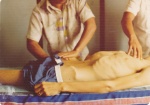
Famous photos:July 1977 Advanced TB or cancer?

The question of timing – why now? Why explore a remission from 30 years ago? If Haines and Lowenthal are correct with their recent IMJ published hypothesis; and I believe from first-hand  being there experience, that they are; then the medical history books must be re-written and Ian must subject himself to appropriate medical scrutiny with regards to his history, presenting his samples for independent pathological examination. Cancer patients base their treatment decisions on Ian Gawler’s story; I hear it in my practise from people with advanced cancer at least 4-5 times per week – “Well if Ian did it , then so can I!” If it wasn’t secondary cancer that he had – cancer patients must know this fact.

This is a scan of a person with TB - mediastinal calcifications are evident

It is interesting to compare these two images. Above left Ian Gawler’s chest wall 7 July 1977. Left: Scan image of a patient with TB (not Ian Gawler) Note: tubercular adenopathy  – abscesses of the lymph nodes. These can become calcified abscesses.

Now – back to Professor Herzog’s paper: This is a medical journal report that highlights the fact that TB can mimick cancer Please select the link to read the PDF: Herzog – Dangerous Errors in the Diagnosis and Treatment of Bony Tuberculosis

In brief: Prof Alex Herzog published a journal article about a patient with tuberculosis of the bone mistaken as metastatic cancer.
The patient had been in a University hospital in Germany and had started induction chemotherapy before he visited Professor Herzog who diagnosed that there was no metastatic cancer but tuberculosis. The patient received treatment and was cured with a combination of antibiotics over 2 years. The article can also be found on the public medical record at:  http://www.ncbi.nlm.nih.gov/pubmed/19890413  The message is clear – biopsies and accurate diagnostics are necessary when dealing with any cancer related situation.


Out on a limb – the importance of re-examining the cause of Ian Gawler’s ‘remission’ – Grace Gawler comments

Visit:  https://theconversation.edu.au/coffee-enemas-dont-cure-cancer-reviewing-the-remarkable-claims-of-ian-gawler-5242

Hopefully this series of blogs will answer the many questions that cancer patients and the public are asking about how Ian Gawler might have been misdiagnosed?

After Meares and Gerson diet: Mid March 1976 – Ian Gawler

 After all, we would normally think of TB being associated with a ‘shadow’ on the lung, not large calcified lumps such as the those photographed on July 7 1977 – Ian’s chest wall…(below left).
In my next blog we will look at how misdiagnosis can happen and how TB can mimic even bone cancer. The following will form a background and framework for what has happened and make sense of this complex story.

Famous photos:July 1977 Advanced TB or cancer?

 I was once quoted as saying “I would rather be married to a live anecdote than a dead statistic.” At that stage I had no idea that our story would become so famous and that people would try to emulate what we did throughout the course of Ian’s illness. I had neither the maturity nor expertise to tease apart various medical incidents that had always left me wondering.

Now in 2012, having walked in the world of cancer medicine for 38 years; by logic, you would have to think that I have seen a thing or two! Add to that my experience as sole caregiver/partner for Ian Gawler throughout his illness; first in 1974 as girlfriend when he was diagnosed with osteogenic sarcoma; then supporting him throughout his assumed recurrence; marrying him when he’d been given a few weeks to live, and following through with support until he returned to full health. Given that background, you would have to think that I know a thing or two!

Coming back to current time, Ian Gawler and supporters mistakenly believe they are at war with the medical profession who are simply out to discredit because he recovered from secondary bone cancer despite them. This debate has reached the heights of blind emotionalism fanned by Gawler’s blogs calling it the Spanish Inquisition! Rather than welcoming enquiry, the Gawler Foundation has published links to these emotive blogs on their front page! Has anyone from this group stopped for moment to consider why, as an ex wife I would expose myself to public and medical scrutiny by correcting errors of fact about Ian Gawler’s ‘remission’ in a medical journal? We separated long ago – so although it makes for exciting press, there are no duelling Mrs Gawler’s as has been implied. I have been preoccupied since 1997 with a medical condition myself and family responsibilities, so could well do without the hassle. We should also ask why two eminent professors of oncology would risk their reputations publically and medically by investigating Ian Gawler’s recovery 30 years on? Bringing a tone of logic to the matter, it is recommended that Ian Gawler’s supporters read the evidence as written in the IMJ report before making assumptions about wars and conspiracies. Haines and Lowenthal’s report is well written and scientifically intelligent and for me who was intimately involved in Ian Gawler’s recovery; in 2012 ‘science-speak’ – it sure makes a lot of sense!

We must remember that medicine was a very different entity in the 1970’s. Sophisticated scanning wasn’t around and diagnostics were perhaps more dependent on the patient’s reporting of symptoms. There were very few medical practitioners involved in Ian Gawler’s case; they were not of long duration and, as well, we had much geographical relocation during his illness. No one picked up the symptoms of TB, no one knew of the BCG vaccines he had used as immune stimulants and no one knew of the tuberculin he used for TB testing cows in veterinary practice in those days. No one asked if indeed there had been a biopsy performed 11 months after amputation when a bony lump appeared in his groin. No one asked about biopsies for the duration of his illness; it was presumed they had been done. Maybe this assumption was due to the fact that Ian Gawler was a Veterinarian who would know these things. In a nutshell, this is how much of his story/history, simply passed under the medical radar without questions and eventually became a well reported ‘anecdotal cure.’

When Ainslie Meares reported Ian’s story in 1978 in the MJA – there was one missing piece to the puzzle – Meares did not know Ian had been diagnosed with advanced TB in June 1978. Meares had written and submitted the abstract when the calcifications on Ian’s Chest disappeared – he too presumed the growths had been metastatic cancer – in the absence of knowledge about Ian’s TB. He also inverted Ian’s medical timeline which has helped fuel the current confusion in terms of what happened when?

The ‘Dragon’s Blessing’, Ian’s biography was published October 2008. Dr Alistair Robertson is quoted in the book. He had reviewed Ian Gawler’s case in 1978 and made the diagnosis of TB.  This was the first time Ian had consulted him, so he had little or no background about the case. He looked at x-rays from previous years; back to 1976 and compared them with the current-time June 1978 films.  Robertson said: “TB had been evident for at least two years” however, the lung ‘shadow’ was evident early in 1976 on x-ray. I remember asking Ian’s radiation oncologist about it in February 1976 but I had never seen TB; as a veterinary nurse in wasn’t in my repertoire. Continue reading “Out on a limb – the importance of re-examining the cause of Ian Gawler’s ‘remission’ – Grace Gawler comments”

Out on a limb – the importance of re-examining the cause of Ian Gawler's 'remission' – Grace Gawler comments

Visit:  https://theconversation.edu.au/coffee-enemas-dont-cure-cancer-reviewing-the-remarkable-claims-of-ian-gawler-5242

Hopefully this series of blogs will answer the many questions that cancer patients and the public are asking about how Ian Gawler might have been misdiagnosed?

After Meares and Gerson diet: Mid March 1976 – Ian Gawler

 After all, we would normally think of TB being associated with a ‘shadow’ on the lung, not large calcified lumps such as the those photographed on July 7 1977 – Ian’s chest wall…(below left).
In my next blog we will look at how misdiagnosis can happen and how TB can mimic even bone cancer. The following will form a background and framework for what has happened and make sense of this complex story.

Famous photos:July 1977 Advanced TB or cancer?

 I was once quoted as saying “I would rather be married to a live anecdote than a dead statistic.” At that stage I had no idea that our story would become so famous and that people would try to emulate what we did throughout the course of Ian’s illness. I had neither the maturity nor expertise to tease apart various medical incidents that had always left me wondering.

Now in 2012, having walked in the world of cancer medicine for 38 years; by logic, you would have to think that I have seen a thing or two! Add to that my experience as sole caregiver/partner for Ian Gawler throughout his illness; first in 1974 as girlfriend when he was diagnosed with osteogenic sarcoma; then supporting him throughout his assumed recurrence; marrying him when he’d been given a few weeks to live, and following through with support until he returned to full health. Given that background, you would have to think that I know a thing or two!

Coming back to current time, Ian Gawler and supporters mistakenly believe they are at war with the medical profession who are simply out to discredit because he recovered from secondary bone cancer despite them. This debate has reached the heights of blind emotionalism fanned by Gawler’s blogs calling it the Spanish Inquisition! Rather than welcoming enquiry, the Gawler Foundation has published links to these emotive blogs on their front page! Has anyone from this group stopped for moment to consider why, as an ex wife I would expose myself to public and medical scrutiny by correcting errors of fact about Ian Gawler’s ‘remission’ in a medical journal? We separated long ago – so although it makes for exciting press, there are no duelling Mrs Gawler’s as has been implied. I have been preoccupied since 1997 with a medical condition myself and family responsibilities, so could well do without the hassle. We should also ask why two eminent professors of oncology would risk their reputations publically and medically by investigating Ian Gawler’s recovery 30 years on? Bringing a tone of logic to the matter, it is recommended that Ian Gawler’s supporters read the evidence as written in the IMJ report before making assumptions about wars and conspiracies. Haines and Lowenthal’s report is well written and scientifically intelligent and for me who was intimately involved in Ian Gawler’s recovery; in 2012 ‘science-speak’ – it sure makes a lot of sense!

We must remember that medicine was a very different entity in the 1970’s. Sophisticated scanning wasn’t around and diagnostics were perhaps more dependent on the patient’s reporting of symptoms. There were very few medical practitioners involved in Ian Gawler’s case; they were not of long duration and, as well, we had much geographical relocation during his illness. No one picked up the symptoms of TB, no one knew of the BCG vaccines he had used as immune stimulants and no one knew of the tuberculin he used for TB testing cows in veterinary practice in those days. No one asked if indeed there had been a biopsy performed 11 months after amputation when a bony lump appeared in his groin. No one asked about biopsies for the duration of his illness; it was presumed they had been done. Maybe this assumption was due to the fact that Ian Gawler was a Veterinarian who would know these things. In a nutshell, this is how much of his story/history, simply passed under the medical radar without questions and eventually became a well reported ‘anecdotal cure.’

When Ainslie Meares reported Ian’s story in 1978 in the MJA – there was one missing piece to the puzzle – Meares did not know Ian had been diagnosed with advanced TB in June 1978. Meares had written and submitted the abstract when the calcifications on Ian’s Chest disappeared – he too presumed the growths had been metastatic cancer – in the absence of knowledge about Ian’s TB. He also inverted Ian’s medical timeline which has helped fuel the current confusion in terms of what happened when?

The ‘Dragon’s Blessing’, Ian’s biography was published October 2008. Dr Alistair Robertson is quoted in the book. He had reviewed Ian Gawler’s case in 1978 and made the diagnosis of TB.  This was the first time Ian had consulted him, so he had little or no background about the case. He looked at x-rays from previous years; back to 1976 and compared them with the current-time June 1978 films.  Robertson said: “TB had been evident for at least two years” however, the lung ‘shadow’ was evident early in 1976 on x-ray. I remember asking Ian’s radiation oncologist about it in February 1976 but I had never seen TB; as a veterinary nurse in wasn’t in my repertoire. Continue reading “Out on a limb – the importance of re-examining the cause of Ian Gawler's 'remission' – Grace Gawler comments”

Ian Gawler Melbourne Age… Cancer experts challenge Gawler's 'cure' – Grace Gawler comments

December 31, 2011 – Chris Johnston senior writer and Julia Medew Health Editor have written a well considered article about Ian Gawler’s cancer ‘remission’ in today’s Age newspaper. Having been Ian’s 24-7 carer and then his wife who saw him through his entire illness, I can only agree with the findings of the two professors quoted in the Age story. Retrospective views in combination with current knowledge must lead to a view that considers scientific knowledge and clinical facts in the absence of hard data. It is important not become focused on an ideology & be open to accepting new evidence and critique…Carl Sagan quote: “Exceptional claims call for exceptional evidence.” is very appropriate. Professors Haines and Lowenthal have indeed presented exceptional evidence in this case.

Grace Gawler – First wife disputes….The Australian Oct 2008

The article is gaining media momentum around the country. For those of you who are regular subscribers to this blog; you are no doubt aware that the Medical Journal of Australia published a refute letter authored by me in 2010 as a response to an inaccurate review of Ian Gawler’s remission story titled “True Stories” MJA Dec 11 2008. The authors of the published manuscript, Dr Ruth Gawler and Professor George Jelinek had reported a previously incorrect clinical timeline, with incorrect dates  along with serious errors and omissions. The famous photograph of Ian’s chest wall  was incorrectly dated – I have the originals. After many attempts to open a dialogue, the authors failed to respond…there was a ‘cocoon of silence’!  Unfortunately, my refute letter was smoke-screened and deemed by media as “quarrels between ex wives” in The Australian newspaper (Oct 2008) while the Australian Doctor reported the published letter quoting the “Duelling Mrs Gawlers”. These were the only 2 follow up articles at the time. A surprise for a subject so important in the public interest and given Ian Gawler later admitted in the Australian Doctor that he knew Ainslie Meares had the timeline of his story wrong – an error of 19 months! Later on his personal blog – Ian Gawler cleverly worded that he had never followed a vegan diet. However, cancer patients in the public domain were never privy to the disclosures.

The real true story therefore did not get to the most important group of people; cancer patients who should know the facts before making informed decisions about what treatments to take on board. Fortunately, my letter alerted two prominent oncologists who took my refute letter seriously and followed their investigations through to today’s exclusive press release to the Melbourne Age which reads:

“AN EXPLOSIVE new medical report has cast doubt on whether Melbourne alternative therapies guru Dr Ian Gawler ever suffered the secondary cancer from which he has claimed for 30 years to have cured himself.

The online report in the Royal Australian College of Physicians’  Internal Medicine Journal says Dr  Gawler, Australia’s most famous cancer survivor and founder of the Gawler Foundation, had advanced tuberculosis rather than the secondary bone cancer he was told he had in the late 1970s….Read more by selecting the link to the Melbourne Age:
http://www.theage.com.au/national/cancer-experts-challenge-gawlers-cure-20111230-1pfns.html

To read more about this intriguing story select the following link. http://gracegawler.com/Institute/?page_id=3454

My Memoirs – ‘Grace, Grit and Gratitude’ – was published (self published) October 1st 2008 after Curtain University’s Black Swan Publishing lost funding for the project. They had listed it for their Blockbuster Christmas release a couple of years prior. The book had been in process for about 8 years and unlike The Dragon’s Blessing, Ian Gawler’s Biography authored by Guy Allenby; Grace , Grit & Gratitude covers areas Allenby omitted and gives a open and frank discussion about the role that TB had likely played in Ian’ Gawler’s recovery. Anomalies and the atypical pathway of his metastases was always a question for me – I knew that his TB diagnosis had  something to do with this extraordinary remission  – but there was non one willing to entertain or discuss the issue. At last – entering 2012, there are some answers for this atypical medical case in which I was so intimately involved.  Grace, Grit and Gratitude is available in soft cover or as a downloadable eBook.

A book that inspires the best in us – whatever the circumstances.

Ian Gawler Melbourne Age… Cancer experts challenge Gawler’s ‘cure’ – Grace Gawler comments

December 31, 2011 – Chris Johnston senior writer and Julia Medew Health Editor have written a well considered article about Ian Gawler’s cancer ‘remission’ in today’s Age newspaper. Having been Ian’s 24-7 carer and then his wife who saw him through his entire illness, I can only agree with the findings of the two professors quoted in the Age story. Retrospective views in combination with current knowledge must lead to a view that considers scientific knowledge and clinical facts in the absence of hard data. It is important not become focused on an ideology & be open to accepting new evidence and critique…Carl Sagan quote: “Exceptional claims call for exceptional evidence.” is very appropriate. Professors Haines and Lowenthal have indeed presented exceptional evidence in this case.

Grace Gawler – First wife disputes….The Australian Oct 2008

The article is gaining media momentum around the country. For those of you who are regular subscribers to this blog; you are no doubt aware that the Medical Journal of Australia published a refute letter authored by me in 2010 as a response to an inaccurate review of Ian Gawler’s remission story titled “True Stories” MJA Dec 11 2008. The authors of the published manuscript, Dr Ruth Gawler and Professor George Jelinek had reported a previously incorrect clinical timeline, with incorrect dates  along with serious errors and omissions. The famous photograph of Ian’s chest wall  was incorrectly dated – I have the originals. After many attempts to open a dialogue, the authors failed to respond…there was a ‘cocoon of silence’!  Unfortunately, my refute letter was smoke-screened and deemed by media as “quarrels between ex wives” in The Australian newspaper (Oct 2008) while the Australian Doctor reported the published letter quoting the “Duelling Mrs Gawlers”. These were the only 2 follow up articles at the time. A surprise for a subject so important in the public interest and given Ian Gawler later admitted in the Australian Doctor that he knew Ainslie Meares had the timeline of his story wrong – an error of 19 months! Later on his personal blog – Ian Gawler cleverly worded that he had never followed a vegan diet. However, cancer patients in the public domain were never privy to the disclosures.

The real true story therefore did not get to the most important group of people; cancer patients who should know the facts before making informed decisions about what treatments to take on board. Fortunately, my letter alerted two prominent oncologists who took my refute letter seriously and followed their investigations through to today’s exclusive press release to the Melbourne Age which reads:

“AN EXPLOSIVE new medical report has cast doubt on whether Melbourne alternative therapies guru Dr Ian Gawler ever suffered the secondary cancer from which he has claimed for 30 years to have cured himself.

The online report in the Royal Australian College of Physicians’  Internal Medicine Journal says Dr  Gawler, Australia’s most famous cancer survivor and founder of the Gawler Foundation, had advanced tuberculosis rather than the secondary bone cancer he was told he had in the late 1970s….Read more by selecting the link to the Melbourne Age:
http://www.theage.com.au/national/cancer-experts-challenge-gawlers-cure-20111230-1pfns.html

To read more about this intriguing story select the following link. http://gracegawler.com/Institute/?page_id=3454

My Memoirs – ‘Grace, Grit and Gratitude’ – was published (self published) October 1st 2008 after Curtain University’s Black Swan Publishing lost funding for the project. They had listed it for their Blockbuster Christmas release a couple of years prior. The book had been in process for about 8 years and unlike The Dragon’s Blessing, Ian Gawler’s Biography authored by Guy Allenby; Grace , Grit & Gratitude covers areas Allenby omitted and gives a open and frank discussion about the role that TB had likely played in Ian’ Gawler’s recovery. Anomalies and the atypical pathway of his metastases was always a question for me – I knew that his TB diagnosis had  something to do with this extraordinary remission  – but there was non one willing to entertain or discuss the issue. At last – entering 2012, there are some answers for this atypical medical case in which I was so intimately involved.  Grace, Grit and Gratitude is available in soft cover or as a downloadable eBook.

A book that inspires the best in us – whatever the circumstances.

Beating the Silence Again Grace Gawler

In 2007 Katherine Kizilos wrote a feature article for the Age newspaper Melbourne. The article begins…” She survived her husband’s illness only to fall prey herself to disease but Katherine Kizilos finds that Grace Gawler used the experience to launch a new life.”Gawler is a name familiar to those who want

Photo : The Mebourne Age

to believe the human spirit conquers disease. Ian Gawler lost his leg to bone cancer but not his life and with wife Grace established in 1981 Australia’s first cancer support service, the Gawler Foundation. CLICK HERE TO READ FULL ARTICLE

My life has had a theme of  issues pertaining to silence – holding silence where appropriate, and breaking silence when essential!

My book Women of Silence (1994) was the first to open doors of communication surrounding breast cancer and emotional recovery – a little spoken of issue in those days; it formed the basis of breast cancer support groups in Australia.
Katherine Kizilos’ 2007 article  after more than 2 decades of silence was the first article to publicly raise the the issue of Ian Gawler’s remission from cancer being in some way associated with tuberculosis – a very important scientific connection to make in the interest of cancer patients. An opportunity to discuss this important topic resurfaced in 2010 when the (MJA) Medical Journal of Australia published my refute letter in response to an incorrect version of Ian’s recovery story that appeared in the MJA in December 2008, under the title “True Stories”. But then – more silence…. with most newspaper medical reporters refusing to comment, with one exception! Continue reading “Beating the Silence Again Grace Gawler”

Grace Gawler – how the uncertainty principle influences patient's choices in cancer treatments

Examining the ‘Uncertainty Principle’ and How it Negatively Influences Cancer Treatment Choices

 As a director of an integrated cancer solutions charity in Queensland, in my years working in the cancer industry, I remain shocked at the large numbers of cancer patients abandoning conventional treatment in favour of alternative therapies. Unfortunately I’ve also seen the terrible results of such choices ranging from emaciation, electrolyte depletion, metabolic exhaustion, insidious spread of cancer and associated pain increase and even death. Why?

More troubling is the number of ‘integrative’medicine GPs who are not; for the patient’s benefit; collaborating or communicating with mainstream doctors, oncologists or other therapists involved in the patients care. I’ve witnessed there to be little or no communication between treating doctors who should all be active members of the team devoted to a patient’s survival.  It’s also important that integrative medicine GPs  don’t abandon scientific training in favour of promoting excessive supplements – often via affiliations or network marketing initiatives or by promoting dubious diets like Gerson, vegan diets, coffee enemas, various electrical treatments and many other forms of therapy whose evidence is questionable.

Whether a combination of positive placebo and supplements, one very common issue is the plight of cancer patients who are surviving on will power and positive thinking…it appears that strategy has a use by date – they eventually hit a brick wall and deteriorate rapidly when there is a sudden downturn in their condition; often a condition that could have been avoided had they sought proper medical advice. It is a trap for the unwary patient because their general wellbeing may have increased temporarily; but what we see far too often are patients who are entranced by some therapists into denial of their symptoms. They have soldiered on and used up a lot of energy in their struggle for survival. The question begs – What is it in the psyche that encourages cancer patients to completely abandon conventional medicine and play Russian roulette with their lives?

Last week I heard a medical doctor say …”We give people antibiotics for an infection – they don’t have to believe in them in order to have them work- the just do!” He has a point!

At the time I had been thinking about a young man in his late teens, a friend of a friend whose mum implicitly believed in natural medicines, refusing medical advice – he had developed pnuemonia – Without treatment, he died within 4 days.
People believe that there is a certainty in natural medicines because they are natural…they can also believe the same of conventional medicine. Perhaps the truth lies somewhere in between…

An article in the Guardian newspaper (UK) – We Must Learn to Love Uncertainty and Failure made these points:-

  1. Uncertainty is a central component of what makes science successful.
  2. The idea of something being “scientifically proven” was practically an oxymoron
  3. The very foundation of science is to keep the door open to doubt.
  4. A ‘good scientist’ is never ‘certain’ – adopts different view if better evidence avails.

Perhaps I had discovered an answer to my questions!

  1. Alternative cancer treatments are promoted with compelling certainty and sophistication.
  2. Simultaneously alt/med amplifies the uncertainty of conventional medicines.
  3. Terminology – ‘slash, burn and poison’ – denigrates conventional treatment and sows fear.
  4. Many patients we see in our practice are terrified to stop taking their supplements. It is implied by some natural therapists that if patients stop using alt/med methods they will die or be toxic from their medical treatments—ironic that an industry that claims to promote wellbeing has an emphasis on fear – the negative placebo.
  5. Alt/med has successfully promoted the image of the greedy ‘big pharma’ but little is said about alt/med avarice, pseudo science and deception – illustrated below.

Last week we met a cancer patient undergoing chemotherapy while simultaneously spending $1100.00 a week on ‘secret’ alternative treatment – but afraid to give it up because it ‘seemed to be working’ – he didn’t notice anything or feel any better – but was afraid to change what he was doing and had been doing for the past 2 years. I recommended an oncologist – He is now in hospital for emergency drainage of ascites ( fluid accumulation in the abdomen) – 10 litres of fluid has been removed. His naturaopath missed the warning signs. This patient is typical of many, who driven by the fear of their diagnosis, don’t want uncertainty and thus are easily lured by the certainty, the increasingly sophisticated ‘pseudo’ science and ‘aura’ of alternate therapies.

Conclusion:  There is an important role for complementary (CAM) therapies in cancer medicine, but the role of alt/med is questionable as is usage of the often touted term ‘evidence-based’ medicine. A recent Medical Journal of Australia (MJA) article disclosed significant errors in a high profile cancer patient recovery story that has influenced the course of alternative, complementary and lifestyle medicine in Australasia for 32 years. It has even influenced peak training bodies such as The Australasian Integrative Medicine Association (AIMA). In the light of the MJA disclosures, the question of what is evidence-based integrative medicine must be addressed in the public interest.

Happily excellent working models exist in Singapore and Hong Kong. These set the standard for excellence for integrative, or as I now like to call it, collaborative cancer medicine. The winner is the cancer patient.
References:

http://www.guardian.co.uk/science/2011/jan/15/uncertainty-failure-edge-question

National Cancer Centre, Singapore (NCCS).   Strong Team-Based, Evidence-based Practice  http://www.nccs.com.sg/medprof/04.htm

Grace Gawler MJA article – Cancer patients at risk from inaccurate clinical reporting in a high-profile alternative treatment story: comments and corrections – Sept 20 2010

http://www.mja.com.au/public/issues/193_06_200910/letters_200910_fm-1.html

Dr Linda Calabresi – Australian Doctor article
http://insidewww.australiandoctor.com.au/news/58/0c06d258.asp

Ian Gawler response – Australian Doctor article
http://www.australiandoctor.com.au/news/50/0c06d750.asp


Grace Gawler – how the uncertainty principle influences patient’s choices in cancer treatments

Examining the ‘Uncertainty Principle’ and How it Negatively Influences Cancer Treatment Choices

 As a director of an integrated cancer solutions charity in Queensland, in my years working in the cancer industry, I remain shocked at the large numbers of cancer patients abandoning conventional treatment in favour of alternative therapies. Unfortunately I’ve also seen the terrible results of such choices ranging from emaciation, electrolyte depletion, metabolic exhaustion, insidious spread of cancer and associated pain increase and even death. Why?

More troubling is the number of ‘integrative’medicine GPs who are not; for the patient’s benefit; collaborating or communicating with mainstream doctors, oncologists or other therapists involved in the patients care. I’ve witnessed there to be little or no communication between treating doctors who should all be active members of the team devoted to a patient’s survival.  It’s also important that integrative medicine GPs  don’t abandon scientific training in favour of promoting excessive supplements – often via affiliations or network marketing initiatives or by promoting dubious diets like Gerson, vegan diets, coffee enemas, various electrical treatments and many other forms of therapy whose evidence is questionable.

Whether a combination of positive placebo and supplements, one very common issue is the plight of cancer patients who are surviving on will power and positive thinking…it appears that strategy has a use by date – they eventually hit a brick wall and deteriorate rapidly when there is a sudden downturn in their condition; often a condition that could have been avoided had they sought proper medical advice. It is a trap for the unwary patient because their general wellbeing may have increased temporarily; but what we see far too often are patients who are entranced by some therapists into denial of their symptoms. They have soldiered on and used up a lot of energy in their struggle for survival. The question begs – What is it in the psyche that encourages cancer patients to completely abandon conventional medicine and play Russian roulette with their lives?

Last week I heard a medical doctor say …”We give people antibiotics for an infection – they don’t have to believe in them in order to have them work- the just do!” He has a point!

At the time I had been thinking about a young man in his late teens, a friend of a friend whose mum implicitly believed in natural medicines, refusing medical advice – he had developed pnuemonia – Without treatment, he died within 4 days.
People believe that there is a certainty in natural medicines because they are natural…they can also believe the same of conventional medicine. Perhaps the truth lies somewhere in between…

An article in the Guardian newspaper (UK) – We Must Learn to Love Uncertainty and Failure made these points:-

  1. Uncertainty is a central component of what makes science successful.
  2. The idea of something being “scientifically proven” was practically an oxymoron
  3. The very foundation of science is to keep the door open to doubt.
  4. A ‘good scientist’ is never ‘certain’ – adopts different view if better evidence avails.

Perhaps I had discovered an answer to my questions!

  1. Alternative cancer treatments are promoted with compelling certainty and sophistication.
  2. Simultaneously alt/med amplifies the uncertainty of conventional medicines.
  3. Terminology – ‘slash, burn and poison’ – denigrates conventional treatment and sows fear.
  4. Many patients we see in our practice are terrified to stop taking their supplements. It is implied by some natural therapists that if patients stop using alt/med methods they will die or be toxic from their medical treatments—ironic that an industry that claims to promote wellbeing has an emphasis on fear – the negative placebo.
  5. Alt/med has successfully promoted the image of the greedy ‘big pharma’ but little is said about alt/med avarice, pseudo science and deception – illustrated below.

Last week we met a cancer patient undergoing chemotherapy while simultaneously spending $1100.00 a week on ‘secret’ alternative treatment – but afraid to give it up because it ‘seemed to be working’ – he didn’t notice anything or feel any better – but was afraid to change what he was doing and had been doing for the past 2 years. I recommended an oncologist – He is now in hospital for emergency drainage of ascites ( fluid accumulation in the abdomen) – 10 litres of fluid has been removed. His naturaopath missed the warning signs. This patient is typical of many, who driven by the fear of their diagnosis, don’t want uncertainty and thus are easily lured by the certainty, the increasingly sophisticated ‘pseudo’ science and ‘aura’ of alternate therapies.

Conclusion:  There is an important role for complementary (CAM) therapies in cancer medicine, but the role of alt/med is questionable as is usage of the often touted term ‘evidence-based’ medicine. A recent Medical Journal of Australia (MJA) article disclosed significant errors in a high profile cancer patient recovery story that has influenced the course of alternative, complementary and lifestyle medicine in Australasia for 32 years. It has even influenced peak training bodies such as The Australasian Integrative Medicine Association (AIMA). In the light of the MJA disclosures, the question of what is evidence-based integrative medicine must be addressed in the public interest.

Happily excellent working models exist in Singapore and Hong Kong. These set the standard for excellence for integrative, or as I now like to call it, collaborative cancer medicine. The winner is the cancer patient.
References:

http://www.guardian.co.uk/science/2011/jan/15/uncertainty-failure-edge-question

National Cancer Centre, Singapore (NCCS).   Strong Team-Based, Evidence-based Practice  http://www.nccs.com.sg/medprof/04.htm

Grace Gawler MJA article – Cancer patients at risk from inaccurate clinical reporting in a high-profile alternative treatment story: comments and corrections – Sept 20 2010

http://www.mja.com.au/public/issues/193_06_200910/letters_200910_fm-1.html

Dr Linda Calabresi – Australian Doctor article
http://insidewww.australiandoctor.com.au/news/58/0c06d258.asp

Ian Gawler response – Australian Doctor article
http://www.australiandoctor.com.au/news/50/0c06d750.asp


Conquering Cancer by Learning From the True Stories of Recovered Patients

Read the latest article on Ezine about how cancer patients can best begin their journey by exzinebuilding resilient foundations.  “…..I have worked at the coal-face of cancer for 35 years with client numbers of over 13,000. I have had the privilege of working with one large targeted group of people with cancer who have been willing to share their mistakes and successes as well as their experiences, choices and outcomes. I listened to them and learned a valuable lesson or two….”
Read the entire article at

http://ezinearticles.com/?Conquering-Cancer-by-Learning-From-the-True-Stories-of-Recovered-Patients&id=5710598

More information about Grace:      www.gracegawler.com  www.gracegawler.com/institute

Lies That Cost Lives-Anecdotes and False Claims in Cancer Care -Grace Gawler Comments

http://www.smh.com.au/lifestyle/lifematters/cured-cancer-patients-died-court-told-20101119-180z9.html

The Australian reporter Debbie Guest has been doing a great job reporting on the case of Hellfried Sartori and now the deaths of 25 cancer patients – linked to his treatments. Sartori is playing a key role in an ongoing inquest in Western Australia. The controversial case is providing a birds-eye view into the cancer cure conundrum that is facing many chronically ill cancer patients around the world. I believe this is the tip of the iceberg in fraudulent cancer-cure discovery.

This blog serves as a vehicle to discovery and disclosure regarding misreporting, poor research, pseudoscience and truth bending that is causing unnecessary pain, stress and suffering to our most vulnerable people – cancer patients. Desperate cancer patients so easily fall prey to treatments that appear to be bone-fide, especially when statistics and high success rates get bandied about. Almost every day another cancer cure product promo virally invades my email inbox! I appreciate the dilemma of choice for patients – but this is certainly a case for the old adage – all that glitters is not gold! The question begs…How can we help cancer patients to discern?   Continue reading “Lies That Cost Lives-Anecdotes and False Claims in Cancer Care -Grace Gawler Comments”

error: Content is protected !!