Hyperthermia in German and American Clinics – follow on from Sunrise Channel 7 Grace Gawler

 The segment on hyperthermia treatment for cancer in Germany on Channel 7’s Sunrise before Christmas 2011, generated a lot interest and enquiry. I will be visiting Germany during the second half of March representing our Institute at a prestigious medical gathering where I will  introduce our original “Collaborative Medicine” concept at an oncology Symposium; the theme being: “New capabilities in laboratory diagnostics and individual therapies in cancer treatment”
We are able to attend the symposium as guest of the organisers and gratefully, our air travel and expenses are paid for; helpful for our Gold Coast non profit organisation. During our stay, we will explore various hyperthermia clinics in Germany and plan to bring back a wealth of literature, studies and ideas. If you are wondering about hyperthermia, how it works and how it can help cancer situations, please watch the following short video from Oncotherm – the manufacture of medical hyperthermia units in Europe.

 [youtube http://www.youtube.com/watch?v=ZhrQ5uu7z-4&w=420&h=315]

We see this trip to Germany as an opportunity to explore first-hand, several clinics includng the hospital of Prof Alex Herzog and the clinics of Dr Ursula Jacob,  and Dr Peter Wolf. All use hyperthermia as a part of a comprehensive cancer treatment program. We will also meet with Prof Thomas Vogl famous for his method of chemotherapy delivery; called chemo-perfusion which is often a partner to hyperthermia treatment, adding to the possibility of successful outcomes.

Hyperthermia is now also used in some hospitals in the USA. Cancer Treatment Centers of America website is now promoting the benefits of hyperthermia in cancer therapy. The following video has excellent information about hyperthermia and as well, there is an inspiring patient story:

[youtube http://www.youtube.com/watch?v=jF-nm8fi3oo&w=420&h=315]
Breast cancer hyperthermia, is now a leading-edge medical treatment in the USA and is used to heat and destroy or damage cancer cells. A non-invasive therapy, breast cancer hyperthermia works by delivering microwave energy directly to the tumor. By exposing a small area of cancerous breast tissue to high temperatures (about 106 degrees), hyperthermia therapy damages proteins and structures within cells, thereby shrinking breast tumors.

The heat increases blood and oxygen circulation within the breast tumor, helping to make cancer cells more vulnerable to the effects of other treatments, like breast cancer radiation therapy and certain chemotherapy drugs. Thus, hyperthermia is often used in conjunction with one of these other therapies. The radiation oncologist  typically uses hyperthermia to treat superficial breast tumors located within a few centimeters from the surface of the body. Hyperthermia is also a promising option if you have advanced or recurrent breast cancer, as the treatment may help to improve your quality of life after breast cancer radiation therapy. To watch a short video about breast cancer hyperthermia- click the link:
http://www.cancercenter.com/breast-cancer/hyperthermia.cfm

The Grace Gawler Institute specialises in preparation, liaison and collaboration with clinics of excellence worldwide so that you can access the best in cancer care. We organise your medical files and dialogue directly with doctors about your treatment plan and quote. All you need to do is arrive at the airport – we ensure you have a friendly face waiting for you at your destination airport. Having had several pioneering surgical procedures myself in a foreign country – I personally appreciate the important journey patients make in order to extend their lives and hopefuly arrest their cancer. Remember also that overseas treatments may not be the magic bullet – there are things you may need to change /attend to in your personal life to lower your risk of recurrence. As well, it is imperative that you have treating oncologist who is prepared to continue treatments or monitor your situation on return to Australia. Support groups after returning can be helpful – we will begin online webinar support groups before June this year – you can log on from anywhere in the world! An announcement will be made on this blog.
All the overseas clinics/hospitals we recommend, practise integrated oncology – they are not alternative medicine practices.
Please contact me for further information at Email: institute@gracegawler.com  website www.gracegawlerinstitute.com 

SE Queenslanders – Please remember to support our Gold Coast Fundraiser 2nd March at Hope Island – Pre-booking is essential contact or buy tickets on line at the website above.
 

Grace Gawler Institute's Services, Events and the Launch of Grace Pink

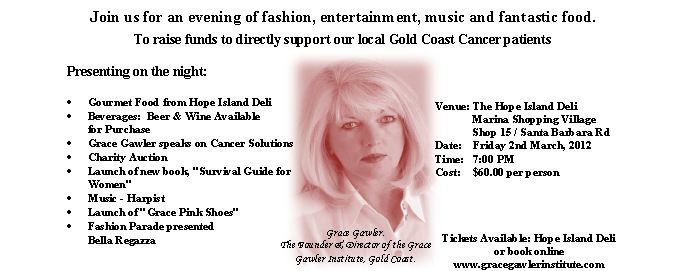
Today the theme of this blog is to let readers know what we are doing at the Grace Gawler Institute for Integrated Cancer Solutions and to invite my Gold Coast subscribers to our March 2 Hope Island fundraiser. Every day we recieve calls from cancer patients who are confused and frightened about what they need to do to get the best results after a diagnosis. Many have tried only alternative medicine and find themselves in dire straits with tumours increasing in size and seemingly no options left; while others are experiencing a recurrence of a previous cancer and may be seeking treatments overseas.

Unfortunately, we mainly see or connect with  patients with advanced cancer because when they were diagnosed, they did not know that any organisation such as ours existed to help them navigate the increasing complex cancer maze. They were not aware of the importance of psycho-oncology or how collaborative medicine could them to fine tune treatment strategies and get all treating practitioners communicating with each other for the patient’s benefit. By the time they reach our Institute, many patients are already finacially exhausted, especially by long term use of expensive alternative medicine supplements. In order to help them, we subsidise their consultations and find innovative ways of referring them into the public system for treatments. We turn no one away and each week we consult with a few patients at no charge. This means that fundraising functions like the one below are very important to us to keep our services active. We receive no Government funding and have limited corporate funding at the moment.

Ways you can support our work: A small amount donated by many, can make a real difference. If you can’t join us for our fundraising evening – you might like to consider a donation to The Grace Gawler Institute  (tax deductible for amounts over $2 for Australian donors) receipts provided. We are a registered non-profit health promotion charity located on Queensland’s Gold Coast. You can also support programs for women with cancer by purchasing on line in my  just released e-Book 23 Feb 2012 Survivors Secrets – A woman’s guide: Strategies for surviving life-challenging illness. All proceeds from this purchase  support our women with cancer programs for 2012.
To buy online ( $9.99 AUD)                    click link to our Bookstore:

                   Our event 2 March 2012: Hope Island Gold Coast:
                   Book online for this “Grace Pink Event”  Click here

 
Tickets will be mailed immediately upon booking or you can… Purchase tickets directly from Grace (07 5577 2997) or from The Hope Island Deli ( address above). All proceeds go directly to support the work of the Grace Gawler Institute’s programs for women with cancer in 2012. Our institute maintains low overheads and admin costs with a high service delivery to patients.

For subscribers who have been enquiring about booking for our one day Survive & Thrive workshops: Please note our new workshop dates have been listed on the website.


Grace Gawler Institute’s Services, Events and the Launch of Grace Pink

Today the theme of this blog is to let readers know what we are doing at the Grace Gawler Institute for Integrated Cancer Solutions and to invite my Gold Coast subscribers to our March 2 Hope Island fundraiser. Every day we recieve calls from cancer patients who are confused and frightened about what they need to do to get the best results after a diagnosis. Many have tried only alternative medicine and find themselves in dire straits with tumours increasing in size and seemingly no options left; while others are experiencing a recurrence of a previous cancer and may be seeking treatments overseas.

Unfortunately, we mainly see or connect with  patients with advanced cancer because when they were diagnosed, they did not know that any organisation such as ours existed to help them navigate the increasing complex cancer maze. They were not aware of the importance of psycho-oncology or how collaborative medicine could them to fine tune treatment strategies and get all treating practitioners communicating with each other for the patient’s benefit. By the time they reach our Institute, many patients are already finacially exhausted, especially by long term use of expensive alternative medicine supplements. In order to help them, we subsidise their consultations and find innovative ways of referring them into the public system for treatments. We turn no one away and each week we consult with a few patients at no charge. This means that fundraising functions like the one below are very important to us to keep our services active. We receive no Government funding and have limited corporate funding at the moment.

Ways you can support our work: A small amount donated by many, can make a real difference. If you can’t join us for our fundraising evening – you might like to consider a donation to The Grace Gawler Institute  (tax deductible for amounts over $2 for Australian donors) receipts provided. We are a registered non-profit health promotion charity located on Queensland’s Gold Coast. You can also support programs for women with cancer by purchasing on line in my  just released e-Book 23 Feb 2012 Survivors Secrets – A woman’s guide: Strategies for surviving life-challenging illness. All proceeds from this purchase  support our women with cancer programs for 2012.
To buy online ( $9.99 AUD)                    click link to our Bookstore:

                   Our event 2 March 2012: Hope Island Gold Coast:
                   Book online for this “Grace Pink Event”  Click here

 
Tickets will be mailed immediately upon booking or you can… Purchase tickets directly from Grace (07 5577 2997) or from The Hope Island Deli ( address above). All proceeds go directly to support the work of the Grace Gawler Institute’s programs for women with cancer in 2012. Our institute maintains low overheads and admin costs with a high service delivery to patients.

For subscribers who have been enquiring about booking for our one day Survive & Thrive workshops: Please note our new workshop dates have been listed on the website.


Ian Gawler 'Cancer Cure': report TB mimicks cancer Professor Alex Herzog – Grace Gawler comments

Professor Alex Herzog is recognised by most cancer patients who have researched integrative oncology or hyperthermia (oncotherm) in Germany. Professor Herzog’s paper “Dangerous Errors in the Diagnosis and Treatment of Bony Tuberculosis” describes a patient who was misdiagnosed with metastatic cancer when in fact he had TB of the bone.

Multiple foci TB spine compression fractures vertebrae

This case demonstrates that even today, misdiagnoses can be made.  Professor Herzog’s report, published in 2009, makes for fascinating reading in relation to the recent case of Ian Gawler.

Since the 31 st December 2011 when the Melbourne Age published the headline: Cancer experts challenge Gawler’s ‘cure’   there has been interest from cancer patients, the general public and some doctors, as to what happened in Ian Gawler’s case. How could TB be mistaken for cancer and the obvious question; why it has taken 30 years to explore an unexpected remission from Australia’s most famous cancer patient?

To answer the above as briefly as possible. No one questioned Ian Gawler’s diagnosis. It was presumed he had metastatic disease. There had only been one diagnostic biopsy in Ian’s medical timeline 1974 – 1978 and that was in January 1975. That biopsy positively identified as osteogenic sarcoma (bone cancer), resulted in his right leg being amputated. From those times there is a lot of evidence in the medical literature, that amputation alone was a cure for some with this disease. 

Because Ian’s prognosis was thought to be poor (if in fact it had been bone cancer) very few medical practitioners became involved in his case during that period; we were mainly in charge of whatever resources we could muster! When Ian first consulted Ainslie Meares in December 1975, Meares also presumed Ian’s illness to be metastatic cancer. When he wrote his famous MJA published abstract in 1978, Regression of osteogenic sarcoma metastases associated with intensive meditation;  it is likely he had no idea Ian had suffered from TB, he certainly had little of the case history; Ian had only attended Meares groups for 6 weeks, stopping the sessions due to his rapid deterioration. His symptoms at that time were not typical of osteogenic sarcoma but with later knowledge were symptoms of TB. Unknown to Meares, Ian had practised a smorgasbord of techniques including imagery, yoga and Buddhist methods forbidden by Meares, as his method was based on stillness and silence. Without an adequate medical history and  background, as well as publishing copious errors of fact;  Ainslie Meares’ acknowledgement and endorsement of Ian Gawler, gave his ‘remission’ story great credibility and served as the fuel that fired an entire alternative medicine movement.

That credibility has never been questioned until now; Prof Haines and Lowenthal have come forward as the only two oncologists who had followed the story, throughout the decades suspecting error. My 2010 MJA letter addressing errors in the story provided them with a series of anomalies that they suspected existed, but were never able to track down.

Famous photos:July 1977 Advanced TB or cancer?

The question of timing – why now? Why explore a remission from 30 years ago? If Haines and Lowenthal are correct with their recent IMJ published hypothesis; and I believe from first-hand  being there experience, that they are; then the medical history books must be re-written and Ian must subject himself to appropriate medical scrutiny with regards to his history, presenting his samples for independent pathological examination. Cancer patients base their treatment decisions on Ian Gawler’s story; I hear it in my practise from people with advanced cancer at least 4-5 times per week – “Well if Ian did it , then so can I!” If it wasn’t secondary cancer that he had – cancer patients must know this fact.

This is a scan of a person with TB - mediastinal calcifications are evident

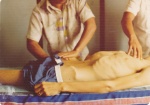
It is interesting to compare these two images. Above left Ian Gawler’s chest wall 7 July 1977. Left: Scan image of a patient with TB (not Ian Gawler) Note: tubercular adenopathy  – abscesses of the lymph nodes. These can become calcified abscesses.

Now – back to Professor Herzog’s paper: This is a medical journal report that highlights the fact that TB can mimick cancer Please select the link to read the PDF: Herzog – Dangerous Errors in the Diagnosis and Treatment of Bony Tuberculosis

In brief: Prof Alex Herzog published a journal article about a patient with tuberculosis of the bone mistaken as metastatic cancer.
The patient had been in a University hospital in Germany and had started induction chemotherapy before he visited Professor Herzog who diagnosed that there was no metastatic cancer but tuberculosis. The patient received treatment and was cured with a combination of antibiotics over 2 years. The article can also be found on the public medical record at:  http://www.ncbi.nlm.nih.gov/pubmed/19890413  The message is clear – biopsies and accurate diagnostics are necessary when dealing with any cancer related situation.


Ian Gawler ‘Cancer Cure’: report TB mimicks cancer Professor Alex Herzog – Grace Gawler comments

Professor Alex Herzog is recognised by most cancer patients who have researched integrative oncology or hyperthermia (oncotherm) in Germany. Professor Herzog’s paper “Dangerous Errors in the Diagnosis and Treatment of Bony Tuberculosis” describes a patient who was misdiagnosed with metastatic cancer when in fact he had TB of the bone.

Multiple foci TB spine compression fractures vertebrae

This case demonstrates that even today, misdiagnoses can be made.  Professor Herzog’s report, published in 2009, makes for fascinating reading in relation to the recent case of Ian Gawler.

Since the 31 st December 2011 when the Melbourne Age published the headline: Cancer experts challenge Gawler’s ‘cure’   there has been interest from cancer patients, the general public and some doctors, as to what happened in Ian Gawler’s case. How could TB be mistaken for cancer and the obvious question; why it has taken 30 years to explore an unexpected remission from Australia’s most famous cancer patient?

To answer the above as briefly as possible. No one questioned Ian Gawler’s diagnosis. It was presumed he had metastatic disease. There had only been one diagnostic biopsy in Ian’s medical timeline 1974 – 1978 and that was in January 1975. That biopsy positively identified as osteogenic sarcoma (bone cancer), resulted in his right leg being amputated. From those times there is a lot of evidence in the medical literature, that amputation alone was a cure for some with this disease. 

Because Ian’s prognosis was thought to be poor (if in fact it had been bone cancer) very few medical practitioners became involved in his case during that period; we were mainly in charge of whatever resources we could muster! When Ian first consulted Ainslie Meares in December 1975, Meares also presumed Ian’s illness to be metastatic cancer. When he wrote his famous MJA published abstract in 1978, Regression of osteogenic sarcoma metastases associated with intensive meditation;  it is likely he had no idea Ian had suffered from TB, he certainly had little of the case history; Ian had only attended Meares groups for 6 weeks, stopping the sessions due to his rapid deterioration. His symptoms at that time were not typical of osteogenic sarcoma but with later knowledge were symptoms of TB. Unknown to Meares, Ian had practised a smorgasbord of techniques including imagery, yoga and Buddhist methods forbidden by Meares, as his method was based on stillness and silence. Without an adequate medical history and  background, as well as publishing copious errors of fact;  Ainslie Meares’ acknowledgement and endorsement of Ian Gawler, gave his ‘remission’ story great credibility and served as the fuel that fired an entire alternative medicine movement.

That credibility has never been questioned until now; Prof Haines and Lowenthal have come forward as the only two oncologists who had followed the story, throughout the decades suspecting error. My 2010 MJA letter addressing errors in the story provided them with a series of anomalies that they suspected existed, but were never able to track down.

Famous photos:July 1977 Advanced TB or cancer?

The question of timing – why now? Why explore a remission from 30 years ago? If Haines and Lowenthal are correct with their recent IMJ published hypothesis; and I believe from first-hand  being there experience, that they are; then the medical history books must be re-written and Ian must subject himself to appropriate medical scrutiny with regards to his history, presenting his samples for independent pathological examination. Cancer patients base their treatment decisions on Ian Gawler’s story; I hear it in my practise from people with advanced cancer at least 4-5 times per week – “Well if Ian did it , then so can I!” If it wasn’t secondary cancer that he had – cancer patients must know this fact.

This is a scan of a person with TB - mediastinal calcifications are evident

It is interesting to compare these two images. Above left Ian Gawler’s chest wall 7 July 1977. Left: Scan image of a patient with TB (not Ian Gawler) Note: tubercular adenopathy  – abscesses of the lymph nodes. These can become calcified abscesses.

Now – back to Professor Herzog’s paper: This is a medical journal report that highlights the fact that TB can mimick cancer Please select the link to read the PDF: Herzog – Dangerous Errors in the Diagnosis and Treatment of Bony Tuberculosis

In brief: Prof Alex Herzog published a journal article about a patient with tuberculosis of the bone mistaken as metastatic cancer.
The patient had been in a University hospital in Germany and had started induction chemotherapy before he visited Professor Herzog who diagnosed that there was no metastatic cancer but tuberculosis. The patient received treatment and was cured with a combination of antibiotics over 2 years. The article can also be found on the public medical record at:  http://www.ncbi.nlm.nih.gov/pubmed/19890413  The message is clear – biopsies and accurate diagnostics are necessary when dealing with any cancer related situation.


Out on a limb – the importance of re-examining the cause of Ian Gawler's 'remission' – Grace Gawler comments

Visit:  https://theconversation.edu.au/coffee-enemas-dont-cure-cancer-reviewing-the-remarkable-claims-of-ian-gawler-5242

Hopefully this series of blogs will answer the many questions that cancer patients and the public are asking about how Ian Gawler might have been misdiagnosed?

After Meares and Gerson diet: Mid March 1976 – Ian Gawler

 After all, we would normally think of TB being associated with a ‘shadow’ on the lung, not large calcified lumps such as the those photographed on July 7 1977 – Ian’s chest wall…(below left).
In my next blog we will look at how misdiagnosis can happen and how TB can mimic even bone cancer. The following will form a background and framework for what has happened and make sense of this complex story.

Famous photos:July 1977 Advanced TB or cancer?

 I was once quoted as saying “I would rather be married to a live anecdote than a dead statistic.” At that stage I had no idea that our story would become so famous and that people would try to emulate what we did throughout the course of Ian’s illness. I had neither the maturity nor expertise to tease apart various medical incidents that had always left me wondering.

Now in 2012, having walked in the world of cancer medicine for 38 years; by logic, you would have to think that I have seen a thing or two! Add to that my experience as sole caregiver/partner for Ian Gawler throughout his illness; first in 1974 as girlfriend when he was diagnosed with osteogenic sarcoma; then supporting him throughout his assumed recurrence; marrying him when he’d been given a few weeks to live, and following through with support until he returned to full health. Given that background, you would have to think that I know a thing or two!

Coming back to current time, Ian Gawler and supporters mistakenly believe they are at war with the medical profession who are simply out to discredit because he recovered from secondary bone cancer despite them. This debate has reached the heights of blind emotionalism fanned by Gawler’s blogs calling it the Spanish Inquisition! Rather than welcoming enquiry, the Gawler Foundation has published links to these emotive blogs on their front page! Has anyone from this group stopped for moment to consider why, as an ex wife I would expose myself to public and medical scrutiny by correcting errors of fact about Ian Gawler’s ‘remission’ in a medical journal? We separated long ago – so although it makes for exciting press, there are no duelling Mrs Gawler’s as has been implied. I have been preoccupied since 1997 with a medical condition myself and family responsibilities, so could well do without the hassle. We should also ask why two eminent professors of oncology would risk their reputations publically and medically by investigating Ian Gawler’s recovery 30 years on? Bringing a tone of logic to the matter, it is recommended that Ian Gawler’s supporters read the evidence as written in the IMJ report before making assumptions about wars and conspiracies. Haines and Lowenthal’s report is well written and scientifically intelligent and for me who was intimately involved in Ian Gawler’s recovery; in 2012 ‘science-speak’ – it sure makes a lot of sense!

We must remember that medicine was a very different entity in the 1970’s. Sophisticated scanning wasn’t around and diagnostics were perhaps more dependent on the patient’s reporting of symptoms. There were very few medical practitioners involved in Ian Gawler’s case; they were not of long duration and, as well, we had much geographical relocation during his illness. No one picked up the symptoms of TB, no one knew of the BCG vaccines he had used as immune stimulants and no one knew of the tuberculin he used for TB testing cows in veterinary practice in those days. No one asked if indeed there had been a biopsy performed 11 months after amputation when a bony lump appeared in his groin. No one asked about biopsies for the duration of his illness; it was presumed they had been done. Maybe this assumption was due to the fact that Ian Gawler was a Veterinarian who would know these things. In a nutshell, this is how much of his story/history, simply passed under the medical radar without questions and eventually became a well reported ‘anecdotal cure.’

When Ainslie Meares reported Ian’s story in 1978 in the MJA – there was one missing piece to the puzzle – Meares did not know Ian had been diagnosed with advanced TB in June 1978. Meares had written and submitted the abstract when the calcifications on Ian’s Chest disappeared – he too presumed the growths had been metastatic cancer – in the absence of knowledge about Ian’s TB. He also inverted Ian’s medical timeline which has helped fuel the current confusion in terms of what happened when?

The ‘Dragon’s Blessing’, Ian’s biography was published October 2008. Dr Alistair Robertson is quoted in the book. He had reviewed Ian Gawler’s case in 1978 and made the diagnosis of TB.  This was the first time Ian had consulted him, so he had little or no background about the case. He looked at x-rays from previous years; back to 1976 and compared them with the current-time June 1978 films.  Robertson said: “TB had been evident for at least two years” however, the lung ‘shadow’ was evident early in 1976 on x-ray. I remember asking Ian’s radiation oncologist about it in February 1976 but I had never seen TB; as a veterinary nurse in wasn’t in my repertoire. Continue reading “Out on a limb – the importance of re-examining the cause of Ian Gawler's 'remission' – Grace Gawler comments”

Out on a limb – the importance of re-examining the cause of Ian Gawler’s ‘remission’ – Grace Gawler comments

Visit:  https://theconversation.edu.au/coffee-enemas-dont-cure-cancer-reviewing-the-remarkable-claims-of-ian-gawler-5242

Hopefully this series of blogs will answer the many questions that cancer patients and the public are asking about how Ian Gawler might have been misdiagnosed?

After Meares and Gerson diet: Mid March 1976 – Ian Gawler

 After all, we would normally think of TB being associated with a ‘shadow’ on the lung, not large calcified lumps such as the those photographed on July 7 1977 – Ian’s chest wall…(below left).
In my next blog we will look at how misdiagnosis can happen and how TB can mimic even bone cancer. The following will form a background and framework for what has happened and make sense of this complex story.

Famous photos:July 1977 Advanced TB or cancer?

 I was once quoted as saying “I would rather be married to a live anecdote than a dead statistic.” At that stage I had no idea that our story would become so famous and that people would try to emulate what we did throughout the course of Ian’s illness. I had neither the maturity nor expertise to tease apart various medical incidents that had always left me wondering.

Now in 2012, having walked in the world of cancer medicine for 38 years; by logic, you would have to think that I have seen a thing or two! Add to that my experience as sole caregiver/partner for Ian Gawler throughout his illness; first in 1974 as girlfriend when he was diagnosed with osteogenic sarcoma; then supporting him throughout his assumed recurrence; marrying him when he’d been given a few weeks to live, and following through with support until he returned to full health. Given that background, you would have to think that I know a thing or two!

Coming back to current time, Ian Gawler and supporters mistakenly believe they are at war with the medical profession who are simply out to discredit because he recovered from secondary bone cancer despite them. This debate has reached the heights of blind emotionalism fanned by Gawler’s blogs calling it the Spanish Inquisition! Rather than welcoming enquiry, the Gawler Foundation has published links to these emotive blogs on their front page! Has anyone from this group stopped for moment to consider why, as an ex wife I would expose myself to public and medical scrutiny by correcting errors of fact about Ian Gawler’s ‘remission’ in a medical journal? We separated long ago – so although it makes for exciting press, there are no duelling Mrs Gawler’s as has been implied. I have been preoccupied since 1997 with a medical condition myself and family responsibilities, so could well do without the hassle. We should also ask why two eminent professors of oncology would risk their reputations publically and medically by investigating Ian Gawler’s recovery 30 years on? Bringing a tone of logic to the matter, it is recommended that Ian Gawler’s supporters read the evidence as written in the IMJ report before making assumptions about wars and conspiracies. Haines and Lowenthal’s report is well written and scientifically intelligent and for me who was intimately involved in Ian Gawler’s recovery; in 2012 ‘science-speak’ – it sure makes a lot of sense!

We must remember that medicine was a very different entity in the 1970’s. Sophisticated scanning wasn’t around and diagnostics were perhaps more dependent on the patient’s reporting of symptoms. There were very few medical practitioners involved in Ian Gawler’s case; they were not of long duration and, as well, we had much geographical relocation during his illness. No one picked up the symptoms of TB, no one knew of the BCG vaccines he had used as immune stimulants and no one knew of the tuberculin he used for TB testing cows in veterinary practice in those days. No one asked if indeed there had been a biopsy performed 11 months after amputation when a bony lump appeared in his groin. No one asked about biopsies for the duration of his illness; it was presumed they had been done. Maybe this assumption was due to the fact that Ian Gawler was a Veterinarian who would know these things. In a nutshell, this is how much of his story/history, simply passed under the medical radar without questions and eventually became a well reported ‘anecdotal cure.’

When Ainslie Meares reported Ian’s story in 1978 in the MJA – there was one missing piece to the puzzle – Meares did not know Ian had been diagnosed with advanced TB in June 1978. Meares had written and submitted the abstract when the calcifications on Ian’s Chest disappeared – he too presumed the growths had been metastatic cancer – in the absence of knowledge about Ian’s TB. He also inverted Ian’s medical timeline which has helped fuel the current confusion in terms of what happened when?

The ‘Dragon’s Blessing’, Ian’s biography was published October 2008. Dr Alistair Robertson is quoted in the book. He had reviewed Ian Gawler’s case in 1978 and made the diagnosis of TB.  This was the first time Ian had consulted him, so he had little or no background about the case. He looked at x-rays from previous years; back to 1976 and compared them with the current-time June 1978 films.  Robertson said: “TB had been evident for at least two years” however, the lung ‘shadow’ was evident early in 1976 on x-ray. I remember asking Ian’s radiation oncologist about it in February 1976 but I had never seen TB; as a veterinary nurse in wasn’t in my repertoire. Continue reading “Out on a limb – the importance of re-examining the cause of Ian Gawler’s ‘remission’ – Grace Gawler comments”

Professor Ian Haines co author Gawler 'cure' challenge also a survivor – Grace Gawler

Unless you are Melbourne based, you may have missed an amazing story that precedes the publication and release of  a medical journal article report that offers a likely hypothesis for the recovery of Ian Gawler – Australia’s most famous recovered cancer patient. The report was reviewed and published recently in the Melbourne Age.  
Professor Ian Haines, a co author with Professor Ray Lowenthal, recently turned the worlds of complementary & alternative medicine upside down when they reported that their research unequivocally found that in Ian Gawler’s case evidence of widespread secondary cancer was lacking, suggesting that based on reviewed evidence not previously available, that the patient Ian had advanced tuberculosis mimicking cancer. (supported by past medical literature searches).

Professor Haines recently experienced his own exciting story of survival.  The e-published Internal Medicine Journal  article may not have had one of its authors alive to discuss the importance of the report to cancer patients because just as Professor Haines was driving out of the Melbourne Cabrini Hospital carpark in late November 2011, on his 57th birthday, he had a cardiac arrest and was clinically dead.
Watch video interview with Professor Haines Channel 7 Melbourne: Click here

Fortunately, Dr Peter Jenkins followed by orderly & CPR expert Jonathon Cooper came to the rescue and in an intense 7 mins effort, Ian was brought back to life – a second chance and a miraculous recovery event. A long time advocate for cancer patients and well published researcher, Professor Haines is now a survivor in his own right. I was thinking about survival yesterday as it was the 10 year anniversary of my own survival when I travelled to the Netherlands to have my “world first” bionic colon implant  – a miraculous surgery that saved my life and gave me back life quality. The lower end of my colon had been paralysed – an unexpected post surgical complication following a hysterectomy in Dec 1997. I am eternally grateful to the researcher/colo-rectal surgeon who took a chance and gave me a second chance at life and a return to my career.

Like Professor Haines – if not for modern medicine, neither of us would be here to continue my work and assist those with life challenging illness.

www.gracegawlerinstitute.com  E- institute@gracegawler.com


Professor Ian Haines co author Gawler ‘cure’ challenge also a survivor – Grace Gawler

Unless you are Melbourne based, you may have missed an amazing story that precedes the publication and release of  a medical journal article report that offers a likely hypothesis for the recovery of Ian Gawler – Australia’s most famous recovered cancer patient. The report was reviewed and published recently in the Melbourne Age.  
Professor Ian Haines, a co author with Professor Ray Lowenthal, recently turned the worlds of complementary & alternative medicine upside down when they reported that their research unequivocally found that in Ian Gawler’s case evidence of widespread secondary cancer was lacking, suggesting that based on reviewed evidence not previously available, that the patient Ian had advanced tuberculosis mimicking cancer. (supported by past medical literature searches).

Professor Haines recently experienced his own exciting story of survival.  The e-published Internal Medicine Journal  article may not have had one of its authors alive to discuss the importance of the report to cancer patients because just as Professor Haines was driving out of the Melbourne Cabrini Hospital carpark in late November 2011, on his 57th birthday, he had a cardiac arrest and was clinically dead.
Watch video interview with Professor Haines Channel 7 Melbourne: Click here

Fortunately, Dr Peter Jenkins followed by orderly & CPR expert Jonathon Cooper came to the rescue and in an intense 7 mins effort, Ian was brought back to life – a second chance and a miraculous recovery event. A long time advocate for cancer patients and well published researcher, Professor Haines is now a survivor in his own right. I was thinking about survival yesterday as it was the 10 year anniversary of my own survival when I travelled to the Netherlands to have my “world first” bionic colon implant  – a miraculous surgery that saved my life and gave me back life quality. The lower end of my colon had been paralysed – an unexpected post surgical complication following a hysterectomy in Dec 1997. I am eternally grateful to the researcher/colo-rectal surgeon who took a chance and gave me a second chance at life and a return to my career.

Like Professor Haines – if not for modern medicine, neither of us would be here to continue my work and assist those with life challenging illness.

www.gracegawlerinstitute.com  E- institute@gracegawler.com


Ian Gawler: Out on a limb – science investigates a miracle 'cure' Grace Gawler comments

Read the latest blog from the USA – Science-based medicine: an intelligent review & comments on the Gawler ‘cure’.
http://www.sciencebasedmedicine.org/index.php/the-cancer-cure-anecdote/

The cancer public needs to be aware of the previously inexplicable anomalies of Ian Gawler’s clinical history and the content and reason behind the  publication of a well researched report that for the first time in more than 3 decades, provides a different perspective & hypothesis for his ‘cure’.
Misinformation is being generated about the motive and intentions behind the latest e-published paper however, cancer patients have not yet had the opportunity to see or the review the full report and discern for themselves the motive and the importance of the publication for the cancer community.

If the history books have written that Ian Gawler had metastatic bone cancer, and…. if it is proven that he actually had widespread TB instead – isn’t this a matter in the public interest?  Many patients say ” If Ian did it – I can do it too!” Many give away conventional oncology believing that lifestyle medicine methods as reported by Gawler & Jelinek in the MJA Dec 11 2008 can impact cancer, and in Ian’s case; likely cured his metastatic cancer.

However that report  is chronologically incorrect with many errors of fact – most patients are not aware of this. Patients should be aware that 2 flawed versions published in the MJA are still listed on the Gawler Foundation media website, despite Ian commenting that the timeline in 1978 & 2008 articles were incorrect. He has also stated on his blog that  he never had a vegan diet…..other issues remain unadressed by the authors. Case report in the December 2008 edition of the Medical Journal of Australia

So getting back to the current IMJ paper –  there is no Spanish Inquisition, no medical profession out to get Ian, and no one in the latest scientific article  is disputing Ian Gawler personally or work wise; the paper is a professional scientific document that takes account of  previously unconnected history surrounding Ian Gawler’s medical timeline and exposes a new and likely hypothesis for his “cure’.

To also be clear – this matter of Ian’s ‘remission/cure’ is not personal. Because I was with Ian throughout his entire recovery process 24/7 – my experience is valid and first-hand. My recorded original medical history is indesputable. I have always had more questions than answers when it came to Ian’s disease process.  I too have devoted my life to assisting cancer patients and those with life challenging illness and I am interested to explore the science and know the truth as this was also a momentus part of my life. What really happened throughout Ian Gawler’s recovery and what was the relationship between his TB and his cancer? This is a scientific and now public issue – not an emotional question. Being a fan of Professor Julius Sumner Miller when I was young – I learned to question and ask his famous question: “Why is it so?”

From my perspective; there are no ‘ex-wives quarrels or duelling Mrs Gawlers’ – as previously reported in the popular press when Ian’s history was challenged previously -in fact such headlines served to smoke-screen important professional issues with regards to my corrections/refute  letter MJA 2010

RE TB – Gawler & Jelinek’s 2008 MJA states that Ian Gawler : “….developed pulmonary tuberculosis in June 1978 and was treated for this condition for 12 months.”
Actually – Ian Gawler did have TB – but he had it for 2+ years – it remained undiagnosed until June 1978.
Haines and Lowenthal’s paper titled Hypothesis: The importance of a histological diagnosis when diagnosing and treating advanced cancer. Famous patient recovery may not have been from metastatic disease” is far from an inflammatory title. Prof Ray Lowenthal and Prof Ian Haines IMJ abstract.
 To be continued….

Cancer Experts Challenge Gawler’s Cure – The Age 31 december 2011 http://www.theage.com.au/national/cancer-experts-challenge-gawlers-cure-20111230-1pfns.html

error: Content is protected !!