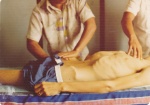
Too Good to be True-Melbourne Age: Grace Gawler Answers Readers Questions

The Melbourne Age has alerted Cancer Patients patients across Australia and around the globe that Ian Gawler likely had TB and not secondary cancer during the 1970’s. Patients are confused, shocked, alarmed and asking questions about the recent controversy

The Melbourne Age has alerted Cancer Patients patients across Australia and around the globe that Ian Gawler likely had TB and not secondary cancer during the 1970’s. Patients are confused, shocked, alarmed and asking questions about the recent controversy. Does Ian Gawler’s ‘cancer-cure’ program work or not?
gracegawlermediablog readers have emailed a number of  questions which I will answer during the next week…..

Mary writes: I attended early groups at the Gawler Foundation; the diet was really helpful to me ,but it seems that at some point, the thrust of the Gawler message changed. I did not have a vegan diet but found the relaxation good. Grace, I am struggling to understand what has happened and why?

Hello Mary….The work of Ian Gawler, myself and the Foundation we co founded in the early 80’s; set a precedent in the way that lifestyle factors could be incorporated into a cancer recovery program. During those early days, the majority of our patients were having conventional therapy or had completed conventional therapies; adding our lifestyle changes as an adjunct to treatments.  Patients were assisted by stress reduction strategies, sensible changes to diet i.e. lowering saturated fats and processed foods, increasing fruit & vegetable consumption and fibre, while lowering red meat & increasing fish consumption. Basically a mediterranean style diet.  We made no claims that the lifestyle cahnges in themselves could or would cure cancer.
I eventually qualified in nutritional studies at distinction level in 1986 and had significant input into the diet presented  at our  residential programs during  the  founding years and up until I resigned in 1996.

At our residentials, a lacto-ovo vegetarian style diet was utilised for convenience- some people on chemo were sensitive to cooking smells such as fish so we did not include it. However a vegetarian diet was recommended as a short-term option for those whose diet was sub optimal before attending a program. I counselled patients in one on one sessions about how they could individualise their diets for optimum help when they returned home. I also referred patients to oncologists, radiation therapists, endocrinologists and GPs recognising they would likely need ongoing assistance and monitoring.

 I resigned in 1996.  In 1997 I was occupied with my own survival and recovery from complications associated with a routine surgery that had left my entire pelvic area and colon paralysed. During the following years significant changes had occurred that deviated from our original story –  the things that Ian and I did to help keep him alive and bring about his recovery had been changed.

A 2008 MJA “True Stories” article was reproduced on the Gawler Foundation website. A former patient alerted me to anomalies in the story and suggested I should investigate. Although I was in recovery from my last surgery performed in Singapore, I researched the article and was shocked by what I read. I wrote to the MJA and suggested they had to correct the errors in the story – lest it become an inaccurate record thereby negatively influencing choices that desperate cancer patients might make. The premise of the article was that:

1. “…Meares and the patient attributed the remarkable recovery to intensive meditation….” 
2. “…He still regularly meditates and teaches others with cancer to do so. His fastidious adoption of the Gerson diet for 3 months, followed by adherence to a plant-based wholefood ‘vegan diet’ may also have played some part. Such a lifestyle approach, incorporating meditation and a vegan diet, has recently been shown to cause significant modulation of gene expression and biological processes associated with tumour growth…”

Regarding these points

1: As a result of my refute letter MJA 2010 – Ian admitted that Meares published incorrect timelines in his 1978 MJA abstract that implied Intensive Meditation had been associated with his remission. The timelines were inverted making it appear that Ian had more ‘tumours’ than he actually did when he first saw Meares. Please refer to Ian Gawler Cancer “Cure’  on the main menu. This fact significantly alters the entire history. It also appears Meares was not informed of Ian’s TB diagnosis in 1978 and the fact it had been present for more than 2 years  as he did not mention it in his abstract. Thirdly, Ian attended Meares sessions for just 6 weeks and could not continue as meditation had not helped his condition-in fact his deterioration caused us to move on from Meares. Against Meares specific advice; Ian experiemented with imagery, mindfulness and many forms of meditation….yet claimed Ian’s recovery was associated with his style of meditation.
Relaxation is very helpful for cancer patients – but I do not believe it to be in any way curative for cancer.

2. Ian never had a vegan diet during the time of his recovery 1975-1978….through until 1997. I pointed this out in my refute letter published in the MJA September 2010. Ian has  since conceded in one of his blogs, that he has never had a vegan diet.

3. His adherance to the Gerson diet played no part in his recovery…he lost weight and deteriorated to the point of being immobilised while on the diet. following our experience, in the early days Ian and I strongly advised cancer patients not to follow the Gerson Diet Regimen.

Meryn writes: Did Ian really have TB or are these oncologists out to get him?

Hello Meryn – I am pleased you asked this question. I am the only living person who was present 24/7 for Ian throughout his illness and so the only one that can truly speak to this controversy. First of all –  It was presumed Ian had secondary cancer- but there were not proper investigations – no biopsy, but his condition was deemed at the time as “not typical of secondary osteogenic sarcoma“. Back then – this was no one’s fault – biopsies weren’t as routine as they are now.

No one is doubting Ian had primary osteogenic sarcoma- he may have even had TB in his bone way back then as we had lots of exposure to Tuberculin, used in our veterinary work to TB test cows. He was likely cured by his primary treatment – leg amputation. Many people were cured by leg amputation in the 1970’s and before that time. But when someone has such an influence on thousands maybe millions of cancer patients saying:  “If I can do it you can do it to…” and… if there is reasonable doubt that the diagnosis even 30 years on was incorrect – this becomes an important public health matter.

There is one way to solve the issue but unfortunately Ian has refused to have the “bone spicules” he coughed up during his recovery, examined. He also has a remaining calcified lymph node in his groin – the first ‘bump’ to appear  in November 1975. This could be biopsied – plus his actual history from the 1970’s could be examined if he wanted to set the record straight.  The latter day accounts of medical interventions that Ian is quoting as proof of his illness are of little relevance to what happened during the 70’s as he had no bony deposits in his lung or chest from 1978 until he left our marriage  in 1997.

In my practice I see a large number of patients who present with horrendous tumours. They have tried meditation, veganism, positive thinking and alternative medicine instead of conventional medicine. Many have spent tens of thousands of dollars on alt med supplements and infusions. Many die as a result of their choice – we help them where possible- but many become palliative patients. This is very sad as some of them would have high potential to be cured by conventional medicine instead of the pain, depression and misery that often results.
As an original inspirer and founder of the Gawler Foundation and the person who assited Ian throughout his illness – I have a public duty of care to raise concerns should any new and plausible view of Ian’s condition be put forward as has been done by Haines and Lowenthals IMJ paper.

Read more at http://gracegawler.com/Institute/?page_id=3454
The Gawler Story is recorded in my Memoirs:  Grace Grit and Gratitude – a self published book.  You can read most of this book online for free via Google books. It is also available from Brumby books Melbourne or via my website Bookshop.


Too Good to be True? Ian Gawler ‘Cure’ Mebourne Age today: Grace Gawler

Too Good to be True? Ian Gawler ‘Cure’ Mebourne Age today: Grace Gawler comments
http://www.theage.com.au/national/health/too-good-to-be-true-20120420-1xcgn.html

http://www.theage.com.au/national/health/too-good-to-be-true-20120420-1xcgn.html

Following on from “Cancer cure” claim – Ian Gawler – A Current Affair, Good Friday;  http://aca.ninemsn.com.au/article/8447811/cancer-cure-claim
this week saw the Melbourne Age newspaper publish not one, but two articles on the controversial subject of Ian Gawler’s remission from bone cancer in 1978.

On Monday 16 April, Dr Rod Anderson, a Melbourne GP said “…he had supported Dr Gawler since he read You Can Conquer Cancer, in which Dr Gawler tells of how he survived secondary cancer, despite being given just months to live. Among other things, Dr Gawler, a veterinarian, says meditation, coffee enemas and controversial alternative healers in the Philippines and India helped cure his cancer. Having been diagnosed with melanoma, Dr Anderson said he wanted to know that there was another option if he ever suffered advanced cancer, but had changed his attitude towards Dr Gawler’s story since he studied the tuberculosis hypothesis.”
http://www.theage.com.au/victoria/gawler-did-not-have-cancer-gp-20120415-1x1vi.html

Today the Melbourne Age published their third article; an in depth feature story about the likelihood that Ian Gawler suffered from advanced TB and not cancer. Gathering more support from various doctors including the eminent integrative  oncologist Prof Alex Herzog from Germany who has revealed a similar case of advanced TB masquerading as bone cancer that he also published in Medical journal said: ”It was clear from the beginning the Gawler case was TB. This was a misdiagnosis.” Herzog said “Gawler’s patients may have been ”misled” into believing they too could be cured by alternative means.”

http://www.theage.com.au/national/health/too-good-to-be-true-20120420-1xcgn.html

Today’s article provides several opinions that lend weight to the fact that Ian Gawler was critically ill with advanced TB and not cancer. Although I was involved with Ian Gawler’s case first hand/24/7, a fact which many seem to ignore; I have always suspected that TB played a role in his recovery. In these early days there was no internet – so research had to be carried out in libraries. I have always been interested in the science aspect of healing and recovery and thrived on the teachings of Prof Julius Sumner Miller’s TV program ‘Why is it so’ when I was in primary school.

I have always asked this question around Ian’s recovery. This whole scenario began without intent to mislead anyone. Misdiagnoses happen all the time – it’s a fact of life. But when we know or suspect there has been an illdocumented case- it is a serious matter…. especially if it becomes famous.
The case demonstrates why I practise the way I do today.

1. Ongoing collaboration between treating practitioners is essential
2. Accurate case notes and records of scans etc need to be catalogued
3. Second or third opinions need to be sought after if any doubt re diagnosis
4. Biopsies must be used to rule out other conditions especially in difficult cases
5. Patient authenticity and disclosure is essential for best results
6. Conventional and complementary treatment concurrently is essential.
7. Consistent monitoring and follow up is necessary – wishful thinking that all is well – is dangerous

As stated before – this is not an attack, not a Spanish Inquisition, not a personal issue from a past marriage breakdown – this is a much overdue scientific appraisal of an issue that affects the decsion making of  the cancer public. In my practice – 4-5 times each week I hear patients saying ” If Ian did it – then I can do it too.” Well – if Ian was misdiagnosed – then surely this has to be the public health issue of the century. The Melbourne Age with true investigative journalism has done a valuable service in letting the public know. More on this in next blog.

You can read the majority of my self-published  memoirs Grace, Grit and Gratitude online at google books for free It is also available from Brumby books Melbourne or on my website in hard copy or e-Book at www.gracegawlerinstitute.com  Email : institute@gracegawler.com

Too Good to be True? Ian Gawler 'Cure' Mebourne Age today: Grace Gawler

Too Good to be True? Ian Gawler ‘Cure’ Mebourne Age today: Grace Gawler comments
http://www.theage.com.au/national/health/too-good-to-be-true-20120420-1xcgn.html

http://www.theage.com.au/national/health/too-good-to-be-true-20120420-1xcgn.html

Following on from “Cancer cure” claim – Ian Gawler – A Current Affair, Good Friday;  http://aca.ninemsn.com.au/article/8447811/cancer-cure-claim
this week saw the Melbourne Age newspaper publish not one, but two articles on the controversial subject of Ian Gawler’s remission from bone cancer in 1978.

On Monday 16 April, Dr Rod Anderson, a Melbourne GP said “…he had supported Dr Gawler since he read You Can Conquer Cancer, in which Dr Gawler tells of how he survived secondary cancer, despite being given just months to live. Among other things, Dr Gawler, a veterinarian, says meditation, coffee enemas and controversial alternative healers in the Philippines and India helped cure his cancer. Having been diagnosed with melanoma, Dr Anderson said he wanted to know that there was another option if he ever suffered advanced cancer, but had changed his attitude towards Dr Gawler’s story since he studied the tuberculosis hypothesis.”
http://www.theage.com.au/victoria/gawler-did-not-have-cancer-gp-20120415-1x1vi.html

Today the Melbourne Age published their third article; an in depth feature story about the likelihood that Ian Gawler suffered from advanced TB and not cancer. Gathering more support from various doctors including the eminent integrative  oncologist Prof Alex Herzog from Germany who has revealed a similar case of advanced TB masquerading as bone cancer that he also published in Medical journal said: ”It was clear from the beginning the Gawler case was TB. This was a misdiagnosis.” Herzog said “Gawler’s patients may have been ”misled” into believing they too could be cured by alternative means.”

http://www.theage.com.au/national/health/too-good-to-be-true-20120420-1xcgn.html

Today’s article provides several opinions that lend weight to the fact that Ian Gawler was critically ill with advanced TB and not cancer. Although I was involved with Ian Gawler’s case first hand/24/7, a fact which many seem to ignore; I have always suspected that TB played a role in his recovery. In these early days there was no internet – so research had to be carried out in libraries. I have always been interested in the science aspect of healing and recovery and thrived on the teachings of Prof Julius Sumner Miller’s TV program ‘Why is it so’ when I was in primary school.

I have always asked this question around Ian’s recovery. This whole scenario began without intent to mislead anyone. Misdiagnoses happen all the time – it’s a fact of life. But when we know or suspect there has been an illdocumented case- it is a serious matter…. especially if it becomes famous.
The case demonstrates why I practise the way I do today.

1. Ongoing collaboration between treating practitioners is essential
2. Accurate case notes and records of scans etc need to be catalogued
3. Second or third opinions need to be sought after if any doubt re diagnosis
4. Biopsies must be used to rule out other conditions especially in difficult cases
5. Patient authenticity and disclosure is essential for best results
6. Conventional and complementary treatment concurrently is essential.
7. Consistent monitoring and follow up is necessary – wishful thinking that all is well – is dangerous

As stated before – this is not an attack, not a Spanish Inquisition, not a personal issue from a past marriage breakdown – this is a much overdue scientific appraisal of an issue that affects the decsion making of  the cancer public. In my practice – 4-5 times each week I hear patients saying ” If Ian did it – then I can do it too.” Well – if Ian was misdiagnosed – then surely this has to be the public health issue of the century. The Melbourne Age with true investigative journalism has done a valuable service in letting the public know. More on this in next blog.

You can read the majority of my self-published  memoirs Grace, Grit and Gratitude online at google books for free It is also available from Brumby books Melbourne or on my website in hard copy or e-Book at www.gracegawlerinstitute.com  Email : institute@gracegawler.com

Ian Gawler ‘Cancer Cure’: report TB mimicks cancer Professor Alex Herzog – Grace Gawler comments

Professor Alex Herzog is recognised by most cancer patients who have researched integrative oncology or hyperthermia (oncotherm) in Germany. Professor Herzog’s paper “Dangerous Errors in the Diagnosis and Treatment of Bony Tuberculosis” describes a patient who was misdiagnosed with metastatic cancer when in fact he had TB of the bone.

Multiple foci TB spine compression fractures vertebrae

This case demonstrates that even today, misdiagnoses can be made.  Professor Herzog’s report, published in 2009, makes for fascinating reading in relation to the recent case of Ian Gawler.

Since the 31 st December 2011 when the Melbourne Age published the headline: Cancer experts challenge Gawler’s ‘cure’   there has been interest from cancer patients, the general public and some doctors, as to what happened in Ian Gawler’s case. How could TB be mistaken for cancer and the obvious question; why it has taken 30 years to explore an unexpected remission from Australia’s most famous cancer patient?

To answer the above as briefly as possible. No one questioned Ian Gawler’s diagnosis. It was presumed he had metastatic disease. There had only been one diagnostic biopsy in Ian’s medical timeline 1974 – 1978 and that was in January 1975. That biopsy positively identified as osteogenic sarcoma (bone cancer), resulted in his right leg being amputated. From those times there is a lot of evidence in the medical literature, that amputation alone was a cure for some with this disease. 

Because Ian’s prognosis was thought to be poor (if in fact it had been bone cancer) very few medical practitioners became involved in his case during that period; we were mainly in charge of whatever resources we could muster! When Ian first consulted Ainslie Meares in December 1975, Meares also presumed Ian’s illness to be metastatic cancer. When he wrote his famous MJA published abstract in 1978, Regression of osteogenic sarcoma metastases associated with intensive meditation;  it is likely he had no idea Ian had suffered from TB, he certainly had little of the case history; Ian had only attended Meares groups for 6 weeks, stopping the sessions due to his rapid deterioration. His symptoms at that time were not typical of osteogenic sarcoma but with later knowledge were symptoms of TB. Unknown to Meares, Ian had practised a smorgasbord of techniques including imagery, yoga and Buddhist methods forbidden by Meares, as his method was based on stillness and silence. Without an adequate medical history and  background, as well as publishing copious errors of fact;  Ainslie Meares’ acknowledgement and endorsement of Ian Gawler, gave his ‘remission’ story great credibility and served as the fuel that fired an entire alternative medicine movement.

That credibility has never been questioned until now; Prof Haines and Lowenthal have come forward as the only two oncologists who had followed the story, throughout the decades suspecting error. My 2010 MJA letter addressing errors in the story provided them with a series of anomalies that they suspected existed, but were never able to track down.

Famous photos:July 1977 Advanced TB or cancer?

The question of timing – why now? Why explore a remission from 30 years ago? If Haines and Lowenthal are correct with their recent IMJ published hypothesis; and I believe from first-hand  being there experience, that they are; then the medical history books must be re-written and Ian must subject himself to appropriate medical scrutiny with regards to his history, presenting his samples for independent pathological examination. Cancer patients base their treatment decisions on Ian Gawler’s story; I hear it in my practise from people with advanced cancer at least 4-5 times per week – “Well if Ian did it , then so can I!” If it wasn’t secondary cancer that he had – cancer patients must know this fact.

This is a scan of a person with TB - mediastinal calcifications are evident

It is interesting to compare these two images. Above left Ian Gawler’s chest wall 7 July 1977. Left: Scan image of a patient with TB (not Ian Gawler) Note: tubercular adenopathy  – abscesses of the lymph nodes. These can become calcified abscesses.

Now – back to Professor Herzog’s paper: This is a medical journal report that highlights the fact that TB can mimick cancer Please select the link to read the PDF: Herzog – Dangerous Errors in the Diagnosis and Treatment of Bony Tuberculosis

In brief: Prof Alex Herzog published a journal article about a patient with tuberculosis of the bone mistaken as metastatic cancer.
The patient had been in a University hospital in Germany and had started induction chemotherapy before he visited Professor Herzog who diagnosed that there was no metastatic cancer but tuberculosis. The patient received treatment and was cured with a combination of antibiotics over 2 years. The article can also be found on the public medical record at:  http://www.ncbi.nlm.nih.gov/pubmed/19890413  The message is clear – biopsies and accurate diagnostics are necessary when dealing with any cancer related situation.


Ian Gawler 'Cancer Cure': report TB mimicks cancer Professor Alex Herzog – Grace Gawler comments

Professor Alex Herzog is recognised by most cancer patients who have researched integrative oncology or hyperthermia (oncotherm) in Germany. Professor Herzog’s paper “Dangerous Errors in the Diagnosis and Treatment of Bony Tuberculosis” describes a patient who was misdiagnosed with metastatic cancer when in fact he had TB of the bone.

Multiple foci TB spine compression fractures vertebrae

This case demonstrates that even today, misdiagnoses can be made.  Professor Herzog’s report, published in 2009, makes for fascinating reading in relation to the recent case of Ian Gawler.

Since the 31 st December 2011 when the Melbourne Age published the headline: Cancer experts challenge Gawler’s ‘cure’   there has been interest from cancer patients, the general public and some doctors, as to what happened in Ian Gawler’s case. How could TB be mistaken for cancer and the obvious question; why it has taken 30 years to explore an unexpected remission from Australia’s most famous cancer patient?

To answer the above as briefly as possible. No one questioned Ian Gawler’s diagnosis. It was presumed he had metastatic disease. There had only been one diagnostic biopsy in Ian’s medical timeline 1974 – 1978 and that was in January 1975. That biopsy positively identified as osteogenic sarcoma (bone cancer), resulted in his right leg being amputated. From those times there is a lot of evidence in the medical literature, that amputation alone was a cure for some with this disease. 

Because Ian’s prognosis was thought to be poor (if in fact it had been bone cancer) very few medical practitioners became involved in his case during that period; we were mainly in charge of whatever resources we could muster! When Ian first consulted Ainslie Meares in December 1975, Meares also presumed Ian’s illness to be metastatic cancer. When he wrote his famous MJA published abstract in 1978, Regression of osteogenic sarcoma metastases associated with intensive meditation;  it is likely he had no idea Ian had suffered from TB, he certainly had little of the case history; Ian had only attended Meares groups for 6 weeks, stopping the sessions due to his rapid deterioration. His symptoms at that time were not typical of osteogenic sarcoma but with later knowledge were symptoms of TB. Unknown to Meares, Ian had practised a smorgasbord of techniques including imagery, yoga and Buddhist methods forbidden by Meares, as his method was based on stillness and silence. Without an adequate medical history and  background, as well as publishing copious errors of fact;  Ainslie Meares’ acknowledgement and endorsement of Ian Gawler, gave his ‘remission’ story great credibility and served as the fuel that fired an entire alternative medicine movement.

That credibility has never been questioned until now; Prof Haines and Lowenthal have come forward as the only two oncologists who had followed the story, throughout the decades suspecting error. My 2010 MJA letter addressing errors in the story provided them with a series of anomalies that they suspected existed, but were never able to track down.

Famous photos:July 1977 Advanced TB or cancer?

The question of timing – why now? Why explore a remission from 30 years ago? If Haines and Lowenthal are correct with their recent IMJ published hypothesis; and I believe from first-hand  being there experience, that they are; then the medical history books must be re-written and Ian must subject himself to appropriate medical scrutiny with regards to his history, presenting his samples for independent pathological examination. Cancer patients base their treatment decisions on Ian Gawler’s story; I hear it in my practise from people with advanced cancer at least 4-5 times per week – “Well if Ian did it , then so can I!” If it wasn’t secondary cancer that he had – cancer patients must know this fact.

This is a scan of a person with TB - mediastinal calcifications are evident

It is interesting to compare these two images. Above left Ian Gawler’s chest wall 7 July 1977. Left: Scan image of a patient with TB (not Ian Gawler) Note: tubercular adenopathy  – abscesses of the lymph nodes. These can become calcified abscesses.

Now – back to Professor Herzog’s paper: This is a medical journal report that highlights the fact that TB can mimick cancer Please select the link to read the PDF: Herzog – Dangerous Errors in the Diagnosis and Treatment of Bony Tuberculosis

In brief: Prof Alex Herzog published a journal article about a patient with tuberculosis of the bone mistaken as metastatic cancer.
The patient had been in a University hospital in Germany and had started induction chemotherapy before he visited Professor Herzog who diagnosed that there was no metastatic cancer but tuberculosis. The patient received treatment and was cured with a combination of antibiotics over 2 years. The article can also be found on the public medical record at:  http://www.ncbi.nlm.nih.gov/pubmed/19890413  The message is clear – biopsies and accurate diagnostics are necessary when dealing with any cancer related situation.


Out on a limb – the importance of re-examining the cause of Ian Gawler's 'remission' – Grace Gawler comments

Visit:  https://theconversation.edu.au/coffee-enemas-dont-cure-cancer-reviewing-the-remarkable-claims-of-ian-gawler-5242

Hopefully this series of blogs will answer the many questions that cancer patients and the public are asking about how Ian Gawler might have been misdiagnosed?

After Meares and Gerson diet: Mid March 1976 – Ian Gawler

 After all, we would normally think of TB being associated with a ‘shadow’ on the lung, not large calcified lumps such as the those photographed on July 7 1977 – Ian’s chest wall…(below left).
In my next blog we will look at how misdiagnosis can happen and how TB can mimic even bone cancer. The following will form a background and framework for what has happened and make sense of this complex story.

Famous photos:July 1977 Advanced TB or cancer?

 I was once quoted as saying “I would rather be married to a live anecdote than a dead statistic.” At that stage I had no idea that our story would become so famous and that people would try to emulate what we did throughout the course of Ian’s illness. I had neither the maturity nor expertise to tease apart various medical incidents that had always left me wondering.

Now in 2012, having walked in the world of cancer medicine for 38 years; by logic, you would have to think that I have seen a thing or two! Add to that my experience as sole caregiver/partner for Ian Gawler throughout his illness; first in 1974 as girlfriend when he was diagnosed with osteogenic sarcoma; then supporting him throughout his assumed recurrence; marrying him when he’d been given a few weeks to live, and following through with support until he returned to full health. Given that background, you would have to think that I know a thing or two!

Coming back to current time, Ian Gawler and supporters mistakenly believe they are at war with the medical profession who are simply out to discredit because he recovered from secondary bone cancer despite them. This debate has reached the heights of blind emotionalism fanned by Gawler’s blogs calling it the Spanish Inquisition! Rather than welcoming enquiry, the Gawler Foundation has published links to these emotive blogs on their front page! Has anyone from this group stopped for moment to consider why, as an ex wife I would expose myself to public and medical scrutiny by correcting errors of fact about Ian Gawler’s ‘remission’ in a medical journal? We separated long ago – so although it makes for exciting press, there are no duelling Mrs Gawler’s as has been implied. I have been preoccupied since 1997 with a medical condition myself and family responsibilities, so could well do without the hassle. We should also ask why two eminent professors of oncology would risk their reputations publically and medically by investigating Ian Gawler’s recovery 30 years on? Bringing a tone of logic to the matter, it is recommended that Ian Gawler’s supporters read the evidence as written in the IMJ report before making assumptions about wars and conspiracies. Haines and Lowenthal’s report is well written and scientifically intelligent and for me who was intimately involved in Ian Gawler’s recovery; in 2012 ‘science-speak’ – it sure makes a lot of sense!

We must remember that medicine was a very different entity in the 1970’s. Sophisticated scanning wasn’t around and diagnostics were perhaps more dependent on the patient’s reporting of symptoms. There were very few medical practitioners involved in Ian Gawler’s case; they were not of long duration and, as well, we had much geographical relocation during his illness. No one picked up the symptoms of TB, no one knew of the BCG vaccines he had used as immune stimulants and no one knew of the tuberculin he used for TB testing cows in veterinary practice in those days. No one asked if indeed there had been a biopsy performed 11 months after amputation when a bony lump appeared in his groin. No one asked about biopsies for the duration of his illness; it was presumed they had been done. Maybe this assumption was due to the fact that Ian Gawler was a Veterinarian who would know these things. In a nutshell, this is how much of his story/history, simply passed under the medical radar without questions and eventually became a well reported ‘anecdotal cure.’

When Ainslie Meares reported Ian’s story in 1978 in the MJA – there was one missing piece to the puzzle – Meares did not know Ian had been diagnosed with advanced TB in June 1978. Meares had written and submitted the abstract when the calcifications on Ian’s Chest disappeared – he too presumed the growths had been metastatic cancer – in the absence of knowledge about Ian’s TB. He also inverted Ian’s medical timeline which has helped fuel the current confusion in terms of what happened when?

The ‘Dragon’s Blessing’, Ian’s biography was published October 2008. Dr Alistair Robertson is quoted in the book. He had reviewed Ian Gawler’s case in 1978 and made the diagnosis of TB.  This was the first time Ian had consulted him, so he had little or no background about the case. He looked at x-rays from previous years; back to 1976 and compared them with the current-time June 1978 films.  Robertson said: “TB had been evident for at least two years” however, the lung ‘shadow’ was evident early in 1976 on x-ray. I remember asking Ian’s radiation oncologist about it in February 1976 but I had never seen TB; as a veterinary nurse in wasn’t in my repertoire. Continue reading “Out on a limb – the importance of re-examining the cause of Ian Gawler's 'remission' – Grace Gawler comments”

Out on a limb – the importance of re-examining the cause of Ian Gawler’s ‘remission’ – Grace Gawler comments

Visit:  https://theconversation.edu.au/coffee-enemas-dont-cure-cancer-reviewing-the-remarkable-claims-of-ian-gawler-5242

Hopefully this series of blogs will answer the many questions that cancer patients and the public are asking about how Ian Gawler might have been misdiagnosed?

After Meares and Gerson diet: Mid March 1976 – Ian Gawler

 After all, we would normally think of TB being associated with a ‘shadow’ on the lung, not large calcified lumps such as the those photographed on July 7 1977 – Ian’s chest wall…(below left).
In my next blog we will look at how misdiagnosis can happen and how TB can mimic even bone cancer. The following will form a background and framework for what has happened and make sense of this complex story.

Famous photos:July 1977 Advanced TB or cancer?

 I was once quoted as saying “I would rather be married to a live anecdote than a dead statistic.” At that stage I had no idea that our story would become so famous and that people would try to emulate what we did throughout the course of Ian’s illness. I had neither the maturity nor expertise to tease apart various medical incidents that had always left me wondering.

Now in 2012, having walked in the world of cancer medicine for 38 years; by logic, you would have to think that I have seen a thing or two! Add to that my experience as sole caregiver/partner for Ian Gawler throughout his illness; first in 1974 as girlfriend when he was diagnosed with osteogenic sarcoma; then supporting him throughout his assumed recurrence; marrying him when he’d been given a few weeks to live, and following through with support until he returned to full health. Given that background, you would have to think that I know a thing or two!

Coming back to current time, Ian Gawler and supporters mistakenly believe they are at war with the medical profession who are simply out to discredit because he recovered from secondary bone cancer despite them. This debate has reached the heights of blind emotionalism fanned by Gawler’s blogs calling it the Spanish Inquisition! Rather than welcoming enquiry, the Gawler Foundation has published links to these emotive blogs on their front page! Has anyone from this group stopped for moment to consider why, as an ex wife I would expose myself to public and medical scrutiny by correcting errors of fact about Ian Gawler’s ‘remission’ in a medical journal? We separated long ago – so although it makes for exciting press, there are no duelling Mrs Gawler’s as has been implied. I have been preoccupied since 1997 with a medical condition myself and family responsibilities, so could well do without the hassle. We should also ask why two eminent professors of oncology would risk their reputations publically and medically by investigating Ian Gawler’s recovery 30 years on? Bringing a tone of logic to the matter, it is recommended that Ian Gawler’s supporters read the evidence as written in the IMJ report before making assumptions about wars and conspiracies. Haines and Lowenthal’s report is well written and scientifically intelligent and for me who was intimately involved in Ian Gawler’s recovery; in 2012 ‘science-speak’ – it sure makes a lot of sense!

We must remember that medicine was a very different entity in the 1970’s. Sophisticated scanning wasn’t around and diagnostics were perhaps more dependent on the patient’s reporting of symptoms. There were very few medical practitioners involved in Ian Gawler’s case; they were not of long duration and, as well, we had much geographical relocation during his illness. No one picked up the symptoms of TB, no one knew of the BCG vaccines he had used as immune stimulants and no one knew of the tuberculin he used for TB testing cows in veterinary practice in those days. No one asked if indeed there had been a biopsy performed 11 months after amputation when a bony lump appeared in his groin. No one asked about biopsies for the duration of his illness; it was presumed they had been done. Maybe this assumption was due to the fact that Ian Gawler was a Veterinarian who would know these things. In a nutshell, this is how much of his story/history, simply passed under the medical radar without questions and eventually became a well reported ‘anecdotal cure.’

When Ainslie Meares reported Ian’s story in 1978 in the MJA – there was one missing piece to the puzzle – Meares did not know Ian had been diagnosed with advanced TB in June 1978. Meares had written and submitted the abstract when the calcifications on Ian’s Chest disappeared – he too presumed the growths had been metastatic cancer – in the absence of knowledge about Ian’s TB. He also inverted Ian’s medical timeline which has helped fuel the current confusion in terms of what happened when?

The ‘Dragon’s Blessing’, Ian’s biography was published October 2008. Dr Alistair Robertson is quoted in the book. He had reviewed Ian Gawler’s case in 1978 and made the diagnosis of TB.  This was the first time Ian had consulted him, so he had little or no background about the case. He looked at x-rays from previous years; back to 1976 and compared them with the current-time June 1978 films.  Robertson said: “TB had been evident for at least two years” however, the lung ‘shadow’ was evident early in 1976 on x-ray. I remember asking Ian’s radiation oncologist about it in February 1976 but I had never seen TB; as a veterinary nurse in wasn’t in my repertoire. Continue reading “Out on a limb – the importance of re-examining the cause of Ian Gawler’s ‘remission’ – Grace Gawler comments”

Professor Ian Haines co author Gawler 'cure' challenge also a survivor – Grace Gawler

Unless you are Melbourne based, you may have missed an amazing story that precedes the publication and release of  a medical journal article report that offers a likely hypothesis for the recovery of Ian Gawler – Australia’s most famous recovered cancer patient. The report was reviewed and published recently in the Melbourne Age.  
Professor Ian Haines, a co author with Professor Ray Lowenthal, recently turned the worlds of complementary & alternative medicine upside down when they reported that their research unequivocally found that in Ian Gawler’s case evidence of widespread secondary cancer was lacking, suggesting that based on reviewed evidence not previously available, that the patient Ian had advanced tuberculosis mimicking cancer. (supported by past medical literature searches).

Professor Haines recently experienced his own exciting story of survival.  The e-published Internal Medicine Journal  article may not have had one of its authors alive to discuss the importance of the report to cancer patients because just as Professor Haines was driving out of the Melbourne Cabrini Hospital carpark in late November 2011, on his 57th birthday, he had a cardiac arrest and was clinically dead.
Watch video interview with Professor Haines Channel 7 Melbourne: Click here

Fortunately, Dr Peter Jenkins followed by orderly & CPR expert Jonathon Cooper came to the rescue and in an intense 7 mins effort, Ian was brought back to life – a second chance and a miraculous recovery event. A long time advocate for cancer patients and well published researcher, Professor Haines is now a survivor in his own right. I was thinking about survival yesterday as it was the 10 year anniversary of my own survival when I travelled to the Netherlands to have my “world first” bionic colon implant  – a miraculous surgery that saved my life and gave me back life quality. The lower end of my colon had been paralysed – an unexpected post surgical complication following a hysterectomy in Dec 1997. I am eternally grateful to the researcher/colo-rectal surgeon who took a chance and gave me a second chance at life and a return to my career.

Like Professor Haines – if not for modern medicine, neither of us would be here to continue my work and assist those with life challenging illness.

www.gracegawlerinstitute.com  E- institute@gracegawler.com


Professor Ian Haines co author Gawler ‘cure’ challenge also a survivor – Grace Gawler

Unless you are Melbourne based, you may have missed an amazing story that precedes the publication and release of  a medical journal article report that offers a likely hypothesis for the recovery of Ian Gawler – Australia’s most famous recovered cancer patient. The report was reviewed and published recently in the Melbourne Age.  
Professor Ian Haines, a co author with Professor Ray Lowenthal, recently turned the worlds of complementary & alternative medicine upside down when they reported that their research unequivocally found that in Ian Gawler’s case evidence of widespread secondary cancer was lacking, suggesting that based on reviewed evidence not previously available, that the patient Ian had advanced tuberculosis mimicking cancer. (supported by past medical literature searches).

Professor Haines recently experienced his own exciting story of survival.  The e-published Internal Medicine Journal  article may not have had one of its authors alive to discuss the importance of the report to cancer patients because just as Professor Haines was driving out of the Melbourne Cabrini Hospital carpark in late November 2011, on his 57th birthday, he had a cardiac arrest and was clinically dead.
Watch video interview with Professor Haines Channel 7 Melbourne: Click here

Fortunately, Dr Peter Jenkins followed by orderly & CPR expert Jonathon Cooper came to the rescue and in an intense 7 mins effort, Ian was brought back to life – a second chance and a miraculous recovery event. A long time advocate for cancer patients and well published researcher, Professor Haines is now a survivor in his own right. I was thinking about survival yesterday as it was the 10 year anniversary of my own survival when I travelled to the Netherlands to have my “world first” bionic colon implant  – a miraculous surgery that saved my life and gave me back life quality. The lower end of my colon had been paralysed – an unexpected post surgical complication following a hysterectomy in Dec 1997. I am eternally grateful to the researcher/colo-rectal surgeon who took a chance and gave me a second chance at life and a return to my career.

Like Professor Haines – if not for modern medicine, neither of us would be here to continue my work and assist those with life challenging illness.

www.gracegawlerinstitute.com  E- institute@gracegawler.com


Ian Gawler: Out on a limb – science investigates a miracle 'cure' Grace Gawler comments

Read the latest blog from the USA – Science-based medicine: an intelligent review & comments on the Gawler ‘cure’.
http://www.sciencebasedmedicine.org/index.php/the-cancer-cure-anecdote/

The cancer public needs to be aware of the previously inexplicable anomalies of Ian Gawler’s clinical history and the content and reason behind the  publication of a well researched report that for the first time in more than 3 decades, provides a different perspective & hypothesis for his ‘cure’.
Misinformation is being generated about the motive and intentions behind the latest e-published paper however, cancer patients have not yet had the opportunity to see or the review the full report and discern for themselves the motive and the importance of the publication for the cancer community.

If the history books have written that Ian Gawler had metastatic bone cancer, and…. if it is proven that he actually had widespread TB instead – isn’t this a matter in the public interest?  Many patients say ” If Ian did it – I can do it too!” Many give away conventional oncology believing that lifestyle medicine methods as reported by Gawler & Jelinek in the MJA Dec 11 2008 can impact cancer, and in Ian’s case; likely cured his metastatic cancer.

However that report  is chronologically incorrect with many errors of fact – most patients are not aware of this. Patients should be aware that 2 flawed versions published in the MJA are still listed on the Gawler Foundation media website, despite Ian commenting that the timeline in 1978 & 2008 articles were incorrect. He has also stated on his blog that  he never had a vegan diet…..other issues remain unadressed by the authors. Case report in the December 2008 edition of the Medical Journal of Australia

So getting back to the current IMJ paper –  there is no Spanish Inquisition, no medical profession out to get Ian, and no one in the latest scientific article  is disputing Ian Gawler personally or work wise; the paper is a professional scientific document that takes account of  previously unconnected history surrounding Ian Gawler’s medical timeline and exposes a new and likely hypothesis for his “cure’.

To also be clear – this matter of Ian’s ‘remission/cure’ is not personal. Because I was with Ian throughout his entire recovery process 24/7 – my experience is valid and first-hand. My recorded original medical history is indesputable. I have always had more questions than answers when it came to Ian’s disease process.  I too have devoted my life to assisting cancer patients and those with life challenging illness and I am interested to explore the science and know the truth as this was also a momentus part of my life. What really happened throughout Ian Gawler’s recovery and what was the relationship between his TB and his cancer? This is a scientific and now public issue – not an emotional question. Being a fan of Professor Julius Sumner Miller when I was young – I learned to question and ask his famous question: “Why is it so?”

From my perspective; there are no ‘ex-wives quarrels or duelling Mrs Gawlers’ – as previously reported in the popular press when Ian’s history was challenged previously -in fact such headlines served to smoke-screen important professional issues with regards to my corrections/refute  letter MJA 2010

RE TB – Gawler & Jelinek’s 2008 MJA states that Ian Gawler : “….developed pulmonary tuberculosis in June 1978 and was treated for this condition for 12 months.”
Actually – Ian Gawler did have TB – but he had it for 2+ years – it remained undiagnosed until June 1978.
Haines and Lowenthal’s paper titled Hypothesis: The importance of a histological diagnosis when diagnosing and treating advanced cancer. Famous patient recovery may not have been from metastatic disease” is far from an inflammatory title. Prof Ray Lowenthal and Prof Ian Haines IMJ abstract.
 To be continued….

Cancer Experts Challenge Gawler’s Cure – The Age 31 december 2011 http://www.theage.com.au/national/cancer-experts-challenge-gawlers-cure-20111230-1pfns.html

error: Content is protected !!